RABASONContact

FOR IMMEDIATE RELEASE

Endodyne™ Receives Federal Trademark Protection, Marking a Major Milestone for Leadership Framework Created by Former First Responder Jeff Robertson

VIRGINIA — Endodyne™, the leadership philosophy and decision-making framework created by leadership coach, business strategist, and former first responder Jeff Robertson, has officially received federal trademark protection from the United States Patent and Trademark Office (USPTO).

The trademark represents more than a legal milestone. It marks the formal recognition of a framework that has evolved through decades of real-world leadership, public safety service, entrepreneurship, coaching, and personal rebuilding.

“Endodyne wasn’t created in a boardroom,” said Robertson. “It was built through experience. Through pressure. Through leadership. Through adversity. Through learning what happens when people spend years reacting to life instead of consciously leading it.”

The word Endodyne combines two concepts:

Endo – from within

Dyne – force, energy, movement

Together, Endodyne represents the inner force that moves a person from awareness to action.

At its core, Endodyne teaches that clarity precedes action and that sustainable leadership begins from within.

A Framework for Modern Leaders

Originally developed through Robertson’s work with business owners, leaders, entrepreneurs, and high performers, Endodyne helps people navigate complexity, pressure, uncertainty, and growth by focusing on awareness, alignment, discernment, and purposeful action.

The framework encourages individuals to ask questions such as:

  • What’s got life on it right now?
  • What am I trying to control?
  • What keeps showing up that I need to stop ignoring?
  • What’s one move I can make today?

Rather than promoting hustle, burnout, or endless productivity, Endodyne emphasizes clarity, intentional action, and conscious leadership.

Advancing the Conversation Around Operator Syndrome

Jeff Robertson’s recent work has focused on helping first responders, leaders, business owners, and high performers better understand the long-term effects of living in a constant state of responsibility, readiness, and pressure. Drawing from emerging research surrounding Operator Syndrome, he explores how cumulative stress, hypervigilance, sleep disruption, emotional suppression, and operational tempo can influence leadership, relationships, decision-making, and identity. Rather than focusing solely on pathology or diagnosis, Robertson’s approach centers on awareness, helping people recognize when the skills that once created success may also be creating friction. His message resonates across public safety, business, and leadership communities because it addresses a common challenge: learning how to keep the strengths that helped us succeed without allowing those same adaptations to quietly define who we become.

Built Through Experience

Jeff Robertson‘s background includes service in emergency medical services, law enforcement, undercover narcotics investigations, business ownership, leadership development, and coaching.

Throughout those experiences, he observed a common challenge across professions:

Many capable people become trapped in operating systems that helped them survive but no longer help them thrive.

That observation became a foundational element of Endodyne.

“One of the biggest lessons I’ve learned is that adaptation is automatic, but evolution is intentional,” Robertson said. “Many people spend years reacting to life without ever stopping to examine what has become normal. Endodyne helps people recognize the difference between what is serving them and what is simply familiar.”

Looking Ahead

The federal trademark provides a foundation for continued growth of the Endodyne ecosystem, including:

  • Leadership coaching
  • Workshops and keynote presentations
  • Executive and High Performer development programs
  • Decision-making frameworks
  • Digital learning experiences
  • Leadership content and publications

As organizations continue searching for ways to lead through uncertainty, complexity, and rapid change, Robertson believes the demand for clarity-driven leadership will only continue to grow.

“People don’t need more noise,” Robertson said. “They need more honesty. More awareness. More discernment. They need the ability to recognize what matters, move with confidence, and lead from a place of alignment instead of reaction.”

About Endodyne™

Endodyne™ is a leadership philosophy and operating framework created by Jeff Robertson. Built on the belief that awareness precedes action, Endodyne helps leaders, business owners, and high performers navigate complexity with greater clarity, courage, and intentionality.

For more information, visit:

Media Contact

Jeff Robertson

Lead From Within. Move The World.
Stop Spending Premium Energy on People Who Haven’t Made a Premium Commitment

One of the hardest lessons I’ve learned is that not everyone deserves the same level of access to your time, energy, attention, and expertise.

For years, I treated everyone the same.

I answered the calls.

Returned the messages.

Took the meetings.

Offered the advice.

Solved the problems.

I genuinely wanted to help.

What I eventually discovered was that some people weren’t looking for help.

They were looking for access.

There’s a difference.

When I look at where energy gets wasted, it usually falls into four categories.

1. Free Advice Seekers

These are the people who ask for guidance repeatedly but never implement it.

They schedule meetings.

Send messages.

Ask questions.

Request introductions.

Want your perspective.

Then they do absolutely nothing with it.

The problem isn’t that they need help.

The problem is that they consume energy without creating movement.

At some point, you have to recognize the difference between someone seeking transformation and someone collecting information.

2. Low-Commitment Clients

These are the people who want elite outcomes without elite commitment.

They want championship results.

They want executive performance.

They want high-level coaching.

But they don’t want to invest the time, effort, accountability, or resources required to get there.

They want coaching prices from Walmart and outcomes from Navy SEAL training.

It doesn’t work that way.

Results follow commitment.

Always have. Always will.

3. Chronic Victims

Life hits all of us.

Everyone gets knocked down.

Everyone faces setbacks.

Victims aren’t defined by what happened to them.

They’re defined by their refusal to move beyond it.

These are the people who want sympathy instead of accountability.

Every solution has a reason it won’t work.

Every opportunity has a reason it won’t help.

Every challenge becomes another chapter in the same story.

You can’t coach someone who is more committed to the problem than the solution.

4. Projects That Don’t Scale

Anything that requires you to personally push every button every day eventually becomes a burden.

If your presence is required for every decision, every action, and every outcome, you’ve built a job, not a system.

High performers often fall into this trap because they’re capable.

They can carry more.

Solve more.

Handle more.

The problem is that capability often disguises unsustainability.

The Operator Difference

What’s interesting is that the best operators tend to behave very differently.

Whether we’re talking about military operators, first responders, elite athletes, or high-performing leaders, certain patterns show up repeatedly.

They:

  • Execute
  • Take ownership
  • Value performance
  • Value accountability
  • Seek feedback
  • Adapt quickly
  • Solve problems
  • Carry responsibility

Operators don’t wait for rescue.

They move.

They assess reality and take action.

That’s one reason the Operator Syndrome conversation interests me so much.

The very traits that create extraordinary performance can eventually create extraordinary strain.

Responsibility becomes over-responsibility.

Ownership becomes isolation.

Accountability becomes self-pressure.

Execution becomes exhaustion.

The answer isn’t abandoning those traits.

The answer is becoming selective with where you invest them.

Because premium energy is a finite resource.

And one of the highest forms of leadership is learning where not to spend it.

Not every problem is yours to solve.

Not every person is ready to change.

Not every opportunity deserves your attention.

Protect the source.

Spend your energy where there is movement, ownership, and life.

Everything else is noise.

Endodyne: When Evolution Becomes Conscious

Why High Performers Keep Running Old Programming

By Jeff Robertson

What if the biggest threat to your future isn’t a competitor, a bad economy, artificial intelligence, or a lack of opportunity?

What if it’s your programming?

Not computer programming.

Your programming.

The invisible code running beneath your decisions, relationships, leadership style, habits, and reactions.

The code you didn’t consciously choose.

The code you’ve been executing for years.

The code producing results whether you realize it or not.

This idea has become the foundation of Endodyne, a leadership philosophy and operating system I created after years of studying leadership, recovery, first responders, entrepreneurs, and high performers.

And I believe it points to one of the most important conversations of our time.

The Question That Changed Everything

Years ago, I lost my law enforcement career after a DUI arrest.

At first, I believed the arrest was the problem.

Then I believed alcohol was the problem.

Then I believed stress was the problem.

Over time, I discovered something deeper.

Those were symptoms.

The real issue lived beneath the surface.

The real issue was the operating system that produced those outcomes.

Like many first responders, I spent years functioning in survival mode.

Like many entrepreneurs, I learned how to push harder.

Like many leaders, I learned how to carry more weight.

The problem?

The same operating system that helped me survive eventually started working against me.

I wasn’t examining the code.

I was executing it.

We Are the First Generation Living Inside an Attention Experiment

I grew up as an unattended Super Mario kid.

Many of you did too.

We were the generation that came home from school, grabbed a snack, turned on Nintendo, and disappeared for hours.

No cell phones.

No location tracking.

No constant supervision.

Just kids figuring things out.

At first glance, it seems harmless.

In many ways, it was.

I have great memories of it. My brain was constantly working to save the princess.

But I also think we were part of one of the largest behavioral experiments in human history.

Think about Super Mario.

Jump.

Coin.

Reward.

Jump.

Reward.

Level up.

Reward.

Die.

Restart.

Immediate feedback. Trying to solve the game to win.

Constant stimulation.

Continuous engagement.

Then the games got more sophisticated.

Then came cable television.

Then the internet.

Then smartphones.

Then social media.

Then algorithms specifically designed to capture and hold attention.

Today many people can’t sit quietly for five minutes without reaching for a screen.

Not because they’re weak.

Because they’ve been conditioned.

But I think there’s another layer to this conversation that most people miss.

Technology wasn’t the issue by itself.

The real question is:

What happens when childhood adversity meets unlimited stimulation?

Because not every kid experienced those years the same way.

For one child, video games were entertainment.

For another child dealing with stress, unpredictability, conflict, loneliness, pressure, or emotional neglect, they may have become something else entirely.

They became predictable.

They became controllable.

They became rewarding.

They became an escape.

A place where the rules made sense.

A place where effort produced results.

A place where failure didn’t define you because you could simply hit restart.

When real life feels uncertain, that’s incredibly attractive.

I’m not suggesting video games caused Operator Syndrome.

I’m suggesting they may have amplified coping mechanisms that were already forming.

The child learns:

“When life feels hard, go somewhere else.”

For some people that becomes gaming.

For others it becomes work.

Achievement.

Alcohol.

Social media.

Shopping.

Chaos.

The behavior changes.

The pattern remains.

And that’s where many high performers get stuck.

They’re not necessarily addicted to a thing.

They’re addicted to changing their state.

The Attention Evolution Gap

Here’s what fascinates me.

Human biology evolved over hundreds of thousands of years.

Technology evolved in a few decades.

Our brains still operate on ancient hardware.

Our environment runs modern software.

That gap creates friction.

Your brain evolved to notice movement.

Danger.

Novelty.

Threats.

Opportunity.

Social acceptance.

Now your phone delivers all of those things every few seconds.

Your nervous system never gets a break.

And eventually people mistake stimulation for purpose.

Activity for progress.

Reaction for leadership.

That’s where many high performers get stuck.

The Evolutionary Leap Nobody Talks About

For billions of years, evolution happened automatically.

Life adapted.

Species changed.

Nature selected.

Then something extraordinary happened.

Humans gained the ability to observe themselves.

Not just observe the world.

Observe their own thoughts.

Observe their own beliefs.

Observe their own behavior.

For the first time in Earth’s history, evolution became conscious.

Think about that.

A fish cannot redesign itself.

A deer cannot question its assumptions.

A squirrel cannot challenge its identity.

Humans can.

We can examine the code.

We can rewrite the code.

We can intentionally evolve.

The question is whether we will.

Operator Syndrome: Living on Autopilot

This is where Operator Syndrome (Check out Chris Frueh’s work) enters the conversation.

Operator Syndrome isn’t simply burnout.

It isn’t simply stress.

It isn’t simply trauma.

Operator Syndrome occurs when people spend years operating from inherited programming rather than intentional design.

The symptoms show up everywhere.

In business.

In leadership.

In parenting.

In relationships.

In recovery.

In decision-making.

The person keeps producing outcomes they don’t want.

Yet they keep running the same code.

The result?

More effort.

More frustration.

More confusion.

The same outcomes.

Different day.

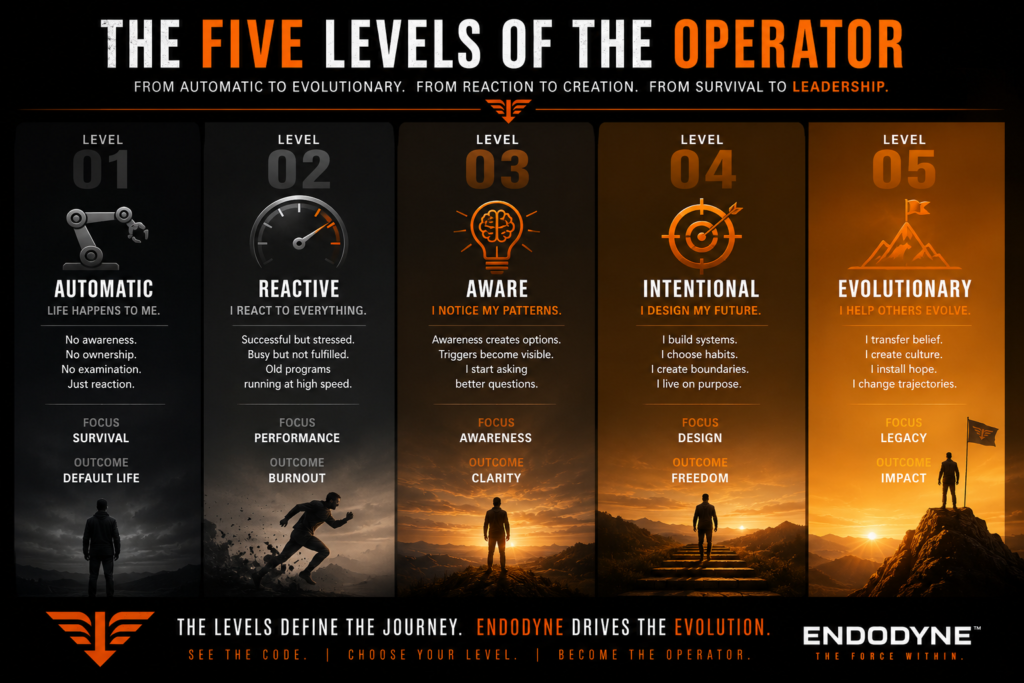
The Five Levels of the Operator

The five levels of the operator

Over the years, I’ve noticed five distinct levels.

Level 1: Automatic

Life happens to me.

No awareness.

No ownership.

No examination.

Level 2: Reactive

The high-performer trap.

Busy.

Driven.

Productive.

Exhausted.

Running old programming at high speed.

Level 3: Aware

The breakthrough.

Patterns become visible.

Triggers become visible.

Beliefs become visible.

Level 4: Intentional

The person begins designing instead of drifting.

Systems replace chaos.

Choices replace reactions.

Level 5: Evolutionary

The person helps others evolve.

This is leadership.

Not title.

Not position.

Transformation.

Why Endodyne Matters

The word Endodyne combines two ideas:

Endo means from within.

Dyne means force or energy.

Endodyne is the force within.

The internal engine that moves someone from awareness into action.

Because awareness alone changes nothing.

You can read every book.

Attend every conference.

Listen to every podcast.

Nothing changes until movement begins.

One of the core principles of Endodyne is simple:

The path confirms itself in motion.

Most people wait for certainty.

Endodyne teaches something different.

Move.

Learn.

Adjust.

Move again.

Truth tends to reveal itself through action.

The Leadership Challenge of the AI Era

Artificial intelligence is changing everything.

But AI isn’t the biggest challenge.

Awareness is.

We have more information than any generation in history.

More tools.

More content.

More options.

More access.

Yet many people feel more disconnected than ever.

Why?

Because information without discernment creates noise.

Endodyne exists to help people separate signal from noise.

To hear themselves clearly.

To stop forcing what is dead.

To move on what is real.

To recognize what keeps showing up.

To stop betraying what they already know.

The future won’t belong to the people with the most information.

The future will belong to the people who can recognize the signal and act on it.

The Endodyne Signal Check

When life gets noisy, ask:

  1. What’s got life on it right now? What feels energized, meaningful, exciting, important, or persistently present in your life right now?
  2. What’s one move I can make today?
  3. What am I trying to control?
  4. What story is slowing me down?
  5. What keeps showing up that I need to stop ignoring?

Those five questions have guided some of the most important decisions of my life.

They continue to guide leaders, entrepreneurs, parents, and high performers who are tired of operating on autopilot.

The Bigger Question

Maybe the most important question isn’t:

“What happened to me?”

Maybe it’s:

“What program produced this outcome?”

Because once you can see the code, you can rewrite it.

Once you can see the pattern, you can interrupt it.

Once you become aware, evolution becomes conscious.

And that may be the greatest leadership opportunity of our time.


About Endodyne

Endodyne is a leadership philosophy created by Jeff Robertson that helps leaders, entrepreneurs, first responders, and high performers recognize the programming driving their decisions, separate signal from noise, and lead from clarity instead of survival mode.

Lead from within. Move the world.

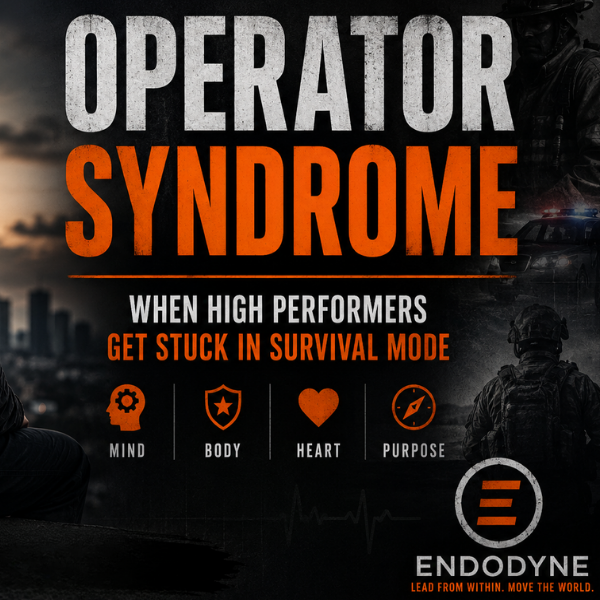
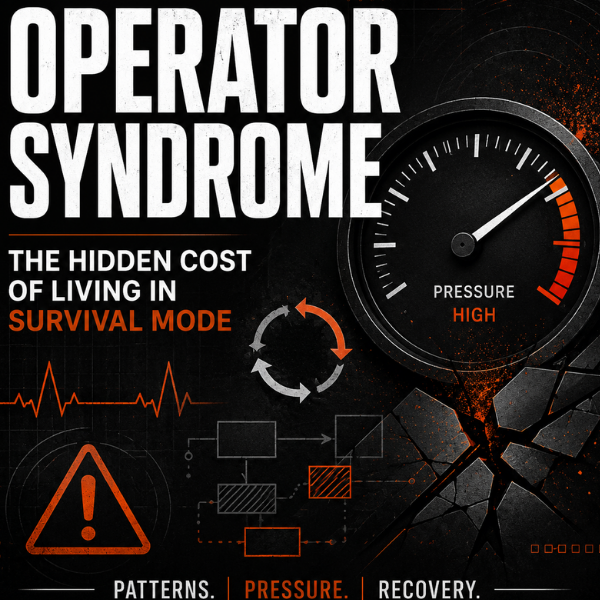
Operator Syndrome: When High Performers Get Stuck in Survival Mode

By Jeff Robertson

Some people break under pressure.

Others become so effective under pressure that they forget how to turn it off.

That’s where the term Operator Syndrome has started gaining attention.

Researchers, veterans, first responders, and high-performance professionals have increasingly used the phrase to describe a pattern seen in people who spend years operating in high-stress environments.

Psychologist and trauma researcher Chris Frueh helped bring attention to the concept through research involving military special operations personnel and the long-term effects of operational stress.

The idea is simple:

Years of constant pressure can shape the way a person thinks, reacts, relates, and moves through the world.

Not just mentally.

Physically, emotionally, socially, and neurologically too.

I understand that mindset because I didn’t just study it.

I lived it.

Long before law enforcement, EMS, undercover work, business, or leadership coaching, my nervous system already learned how to survive instability.

I grew up around adversity early.

As a kid, I found my grandmother after she passed away. The same day, I experienced something I still struggle to fully explain rationally. Whether people believe in paranormal experiences or not, moments like that leave an imprint on you.

Especially when you’re young.

You stop seeing the world the same way after certain experiences.

At 15 years old, I entered EMS.

Most teenagers are still figuring out identity, friendships, and high school life.

I stepped into:

  • emergencies
  • death
  • adrenaline
  • chaos
  • responsibility
  • crisis environments

before adulthood even fully formed.

Then came:

  • EMS
  • 911
  • police work
  • undercover operations
  • high-pressure leadership environments
  • business ownership
  • rebuilding seasons
  • personal mistakes
  • hard resets

For years, I said something many operators quietly understand:

“I never felt like I earned the title PTSD… but I knew something changed in me.”

That tension matters.

Because many operators do not fully relate to the public image of PTSD.

They still function.
Still work.
Still lead.
Still provide.
Still perform under pressure.

From the outside, they look disciplined and capable.

Internally, something feels different.

The mind stays scanning.
The body stays ready.
The nervous system struggles to fully power down.

Stillness can feel unnatural.

Peace can almost feel suspicious.

That does not mean someone is weak.

It also does not mean they are pretending.

It means years of operational conditioning shaped how they move through life.

Humans adapt to environments.

Operators adapt deeply.

What Operator Syndrome Actually Looks Like

Operator Syndrome is not a formal clinical diagnosis.

It’s better understood as a pattern of long-term operational conditioning.

Frueh’s research describes it as a “unique constellation” of overlapping medical, neurological, emotional, behavioral, and quality-of-life impairments connected to prolonged high-stress operational environments.

The research focused specifically on military special operations personnel, but the pattern strongly resonates across:

  • law enforcement
  • first responders
  • executives
  • entrepreneurs
  • medical professionals
  • public safety leadership
  • high-responsibility environments

Many high performers adapt so thoroughly to pressure, readiness, responsibility, and crisis management that their nervous system struggles to shift back into calm, connection, and recovery.

From the outside, these people often look highly capable.

Disciplined.
Reliable.
Focused.
Driven.

Internally, many feel:

  • constantly “on”
  • emotionally armored
  • unable to relax
  • disconnected from stillness
  • restless without pressure
  • guilty when resting
  • hyperaware of everything around them

The same conditioning that makes someone effective under pressure can quietly become destructive when left unmanaged.

That’s the part many people never talk about.

The Difference Between Trauma and Operational Conditioning

One of the most important contributions from researchers like Chris Frueh is the recognition that not every struggling operator fits neatly into traditional PTSD frameworks.

PTSD is real.

Trauma is real.

But sometimes the issue is not one catastrophic event.

Sometimes the issue is years of:

  • hypervigilance
  • mission-first thinking
  • emotional suppression
  • threat anticipation
  • sleep disruption
  • adrenaline conditioning
  • constant responsibility
  • high-stakes decision-making

Frueh’s paper points toward what researchers call allostatic load, which is essentially the accumulated wear and tear on the nervous system and body caused by prolonged stress exposure.

Translated into plain language:

Years of pressure change people.

Over time, those adaptations become identity.

The operator does not just perform the role anymore.

The operator becomes the role.

That distinction matters.

Because many high performers think:
“If I’m still functioning, then I must be fine.”

Meanwhile their nervous system never fully powers down.

Operator Syndrome: When High Performers Get Stuck in Survival Mode

The Dangerous Part Nobody Notices

Operator Syndrome rarely looks weak from the outside.

In fact, society often rewards it.

People praise:

  • the discipline
  • the composure
  • the sacrifice
  • the output
  • the toughness
  • the reliability

Meanwhile the internal cost keeps building.

Relationships suffer.
Emotional connection weakens.
Identity narrows.
Stillness disappears.

Some operators eventually realize they feel more comfortable inside chaos than peace.

That realization hits hard.

Especially after:

  • retirement
  • career changes
  • divorce
  • burnout
  • loss of mission
  • stepping away from high-intensity environments

Because once the pressure changes, a difficult question appears:

“Who am I when I’m no longer needed in crisis mode?”

That question wrecks more people than they admit.

Awareness Versus Hypervigilance

Frueh’s research specifically references operators remaining “on guard” and hypervigilant long after leaving operational environments.

There’s an important difference between awareness and hypervigilance.

Awareness says:
“I can respond if something happens.”

Hypervigilance says:
“I must constantly prepare for something happening.”

One creates clarity.

The other creates exhaustion.

That distinction matters in leadership, parenting, business, and relationships.

Because many operators bring battlefield energy into environments that require:

  • patience
  • emotional availability
  • creativity
  • flexibility
  • presence

You cannot stay fully connected to people while permanently operating behind armor.

Eventually the armor that protected you starts isolating you.

What Actually Helps

The answer is not becoming soft.

The answer is regaining conscious control over your internal state instead of living in permanent activation.

That starts with:

  • recognizing the conditioning
  • understanding what kept you alive
  • separating useful adaptations from unnecessary activation
  • rebuilding trust in calm
  • reconnecting to purpose outside pressure
  • allowing identity to expand beyond performance

One of the hardest truths operators face is this:

The traits that helped you survive one season can quietly damage the next season if left unchecked.

That does not make you broken.

It makes you conditioned.

And conditioning can be examined, adjusted, and redirected.

Questions Worth Asking Yourself

If this hits home, sit with these questions honestly:

  • What am I constantly preparing for?
  • Where do I create unnecessary tension?
  • Have I confused readiness with purpose?
  • What relationships are paying the price for my constant vigilance?
  • What happens when I stop gripping so tightly?
  • Who am I outside performance and pressure?
  • What truth have I been too busy to face?

Those questions matter.

Because many operators spent years learning how to survive hard environments.

Very few learned how to live fully outside them.

And that may be the next level of leadership.

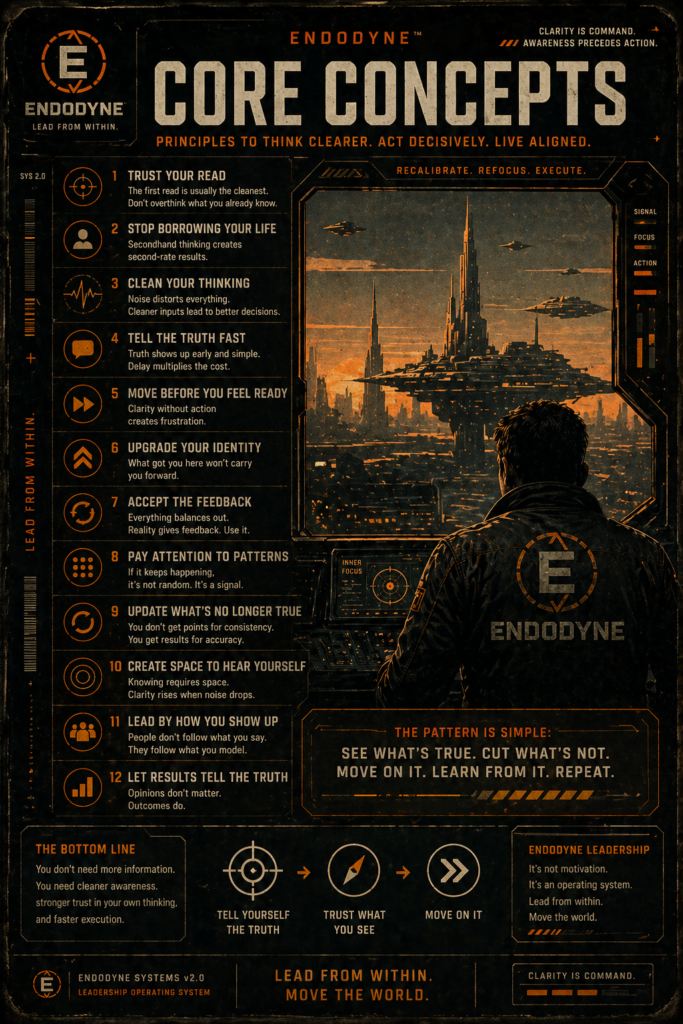
Trust Your Thinking. Move on It. Adjust Fast.

Most people don’t fail because they lack ability.
They fail because their thinking gets noisy… and their action slows down.

You feel the right move early.
Then you hesitate. You gather opinions. You soften the truth.

Now you’re “thinking.”

You’re not. You’re drifting.

Endodyne exists to fix that.
Clarity is command. Awareness precedes action.

Here’s how the core ideas actually work in real life.


1) Trust your read

You don’t need more input.
You need to back what you already see.

The first read is usually the cleanest:

  • the hire isn’t right
  • the deal isn’t real
  • the direction feels off

You knew it. You didn’t trust it.

What to do next:
Pick one decision you’ve been circling.
Write the first answer you had.
Act on it within 24 hours.


2) Stop borrowing your life

Secondhand thinking creates second-rate results.

If your decisions come from:

  • what others expect
  • what looks safe
  • what keeps the peace

you’ll look aligned and feel off.

Under pressure, that breaks.

What to do next:
Find one area where you’re playing to approval.
Reset the standard. Make one move that’s yours, not theirs.


3) Clean your thinking

Noise distorts everything:

  • fear
  • ego
  • comfort
  • approval

Bad inputs → bad decisions → bad outcomes.

You don’t need more ideas. You need cleaner ones.

What to do next:
Before your next big decision, cut input for 10 minutes.
No phone. No opinions.
Ask: What’s actually true here?
Decide from that.


4) Tell the truth fast

Truth shows up early and simple.

You delay it because it costs something:

  • a hard conversation
  • a change in direction
  • letting go of what’s comfortable

Delay multiplies the cost.

What to do next:
Finish this sentence: “I’ve been pretending that…”
Then address it today. Not later.


5) Move before you feel ready

Clarity without action creates frustration.

You don’t build confidence by thinking.
You build it by moving and reading what happens.

Action creates power.

What to do next:
Define the smallest real move you can make.
Do it today. No perfect plan.


6) Upgrade your identity

What got you here won’t carry you forward.

Growth requires:

  • new standards
  • new behavior
  • letting go of who you were

Most people stall because they protect the old version of themselves.

What to do next:
Ask: What version of me is this next level requiring?
Adopt one behavior from that version now.


7) Accept the feedback

Everything balances out.

Avoidance shows up later:

  • in your results
  • in your team
  • in your stress

Reality gives feedback. Use it.

What to do next:
Look at one area that isn’t working.
Don’t explain it. Read it.
Ask: What is this result telling me about my decisions?


8) Pay attention to patterns

If it keeps happening, it’s not random.

Same problems. Same outcomes. Same frustrations.

That’s a signal you haven’t acted on yet.

What to do next:
Write down a repeating issue in your life or business.
Identify the decision you keep avoiding inside it.
Make it.


9) Update what’s no longer true

Old beliefs become liabilities when they outlive their usefulness.

You don’t get points for consistency.
You get results for accuracy.

If it’s not true anymore, drop it.

What to do next:
List one belief that used to serve you but now limits you.
Replace it with a standard that fits where you’re going.


10) Create space to hear yourself

You can’t think clearly in constant input.

There’s a difference between reacting and knowing.

Knowing requires space.

What to do next:
Build a daily 5-minute reset:

  • no input
  • no distraction
  • just observe your thinking

Clarity rises when noise drops.


11) Lead by how you show up

People don’t follow what you say.
They follow what you model.

Your team, your clients, your kids read your energy:

  • your standards
  • your consistency
  • your decisions

What to do next:
Ask: What am I reinforcing right now through my behavior?
Fix that before you fix anything else.


12) Let results tell the truth

Opinions don’t matter if outcomes say otherwise.

  • What’s working?
  • What’s not?
  • What keeps breaking?

Reality is the scoreboard.

What to do next:
Pick one metric that matters.
Track it weekly.
Adjust based on results, not emotion.


The pattern

This isn’t complicated:

  • See what’s true
  • Cut what’s not
  • Move on it
  • Learn from it

Repeat.

That’s how you stop drifting.


The bottom line

You don’t need more information.

You need:

  • cleaner awareness
  • stronger trust in your own thinking
  • faster execution

Everything changes when you do three things:

Tell yourself the truth
Trust what you see
Move on it


Your move

Take one decision you’ve been delaying.

Today.

No more input.
No more waiting.

Make the call.
Take the action.
Read what happens.

That’s how this becomes real.

Join the Conversation

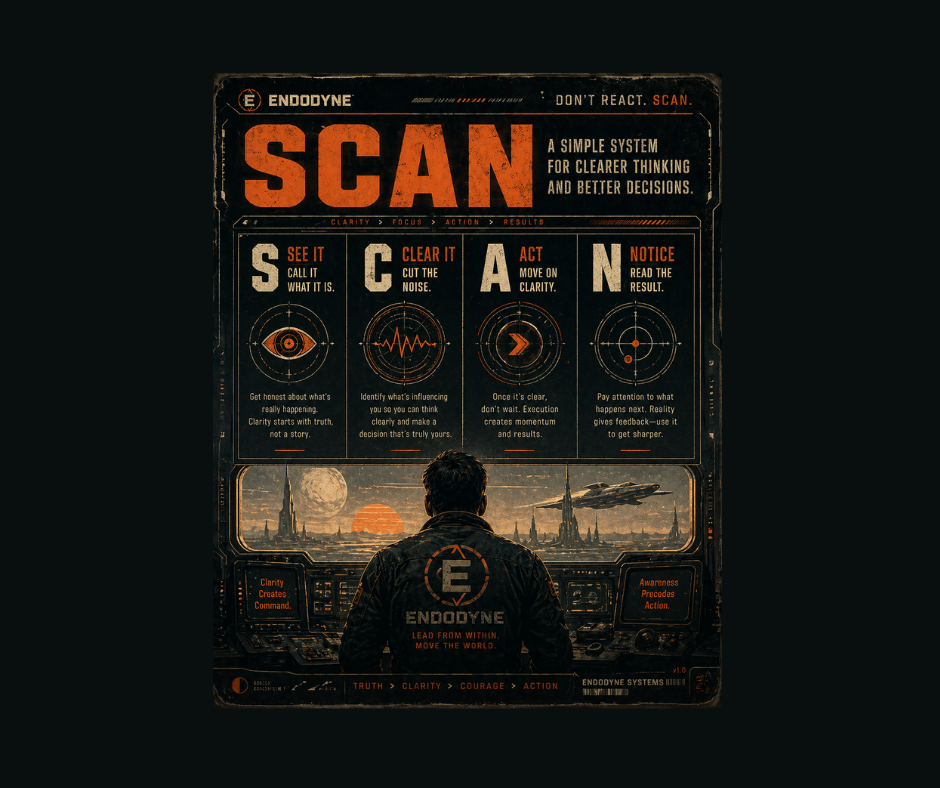
Don’t React. SCAN.How High Performers Make Better Decisions Under Pressure


You’re not overwhelmed. You’re reacting.

Most people think their problem is pressure.

It’s not.

It’s how they handle it.

Something goes wrong:

  • a deal stalls
  • a team member underperforms
  • a decision gets heavy

And instantly, your thinking speeds up.

You start:

  • overanalyzing
  • second-guessing
  • reacting emotionally

Now you’re not leading.

You’re reacting.

That’s where bad decisions happen.


The difference between average and elite

Top performers don’t avoid pressure.

They operate differently inside it.

They slow the moment down.
They get clear.
They act with intent.

Not perfect.

Clear.

That’s the difference.


The problem no one calls out

You usually know what to do.

You feel it early.

Then you:

  • ask too many people
  • hesitate
  • try to make it perfect

Now it’s gone.

Not because you didn’t have the answer.

Because you didn’t trust it.


A better way to operate

When pressure hits, you need something simple.

Not a long process.
Not theory.

Something you can run in real time.

That’s where this comes in:

Don’t React. SCAN.How High Performers Make Better Decisions Under Pressure

SCAN


S — See It

Call it what it is

Most people soften the truth.

They say:

  • “It’s complicated”
  • “I need more time”

But the reality is usually simple:

You already see the issue.
You just don’t want to say it out loud.

Question:
What do I already know that I’m not acknowledging?

Truth shows up early.

If you miss it, everything after gets harder.


C — Clear It

Cut the noise

Now identify what’s getting in your way.

  • fear of being wrong
  • pressure from others
  • desire to be liked
  • ego

That’s not clarity. That’s influence.

Question:
What pressure or opinion is clouding my thinking?

When you remove the noise, the answer usually gets obvious.


A — Act

Move on clarity

This is where most people fail.

They get clear… then hesitate.

They wait for:

  • perfect timing
  • more certainty
  • less risk

That delay costs them.

Question:
What’s the next move I know I should make?

Clarity without action turns into frustration.

Movement creates momentum.


N — Notice

Read the result

Now you watch what happens.

Not emotionally. Objectively.

  • Did it move things forward?
  • Did it create resistance?
  • Did it clarify the next step?

Reality gives feedback fast.

Most people just ignore it.

Question:
What did that just show me?

That’s how you improve in real time.


This applies everywhere

Leadership
Sales
Business
Relationships
Life decisions

Pressure doesn’t change the system.

It exposes how you think.


The real shift

Right now, most people operate like this:

React → Overthink → Hesitate → Drift

High performers operate like this:

See → Clear → Act → Notice

That’s it.


The takeaway

You don’t need more information.

You need:

  • cleaner thinking
  • faster action
  • better awareness under pressure

Because most of the time…

You’re not stuck.

You’re reacting.


Final line

Don’t react.

SCAN.


Here’s what to do next

Pick one decision you’ve been sitting on.

Right now.

Ask:

  • What do I already know?
  • What’s influencing me?
  • What’s the move?

Then act.

Watch what happens.

That’s how this becomes real.

Join the Conversation

12 Signs You’re a People Pleaser And How To Break Free

People pleasing feels like being a good person.
It is not.
It is self betrayal wrapped in politeness.

You keep saying yes.
You avoid conflict.
You take on everyone else’s stress.

That habit robs your confidence, your time, and your authority. If you want stronger leadership, better relationships, and real peace of mind, you have to stop living for other people’s approval.

Here is how to spot it and how to kill it.


1. You say yes too often

You say yes even when it costs you.
Do this instead: “I would love to help, but I do not have the capacity right now.”

2. You apologize when you did nothing wrong

You overuse the word sorry.
Do this instead: “Do you have a moment?”

3. You carry other people’s emotions

You feel responsible for their moods.
Do this instead: Remind yourself their emotions are not your responsibility.

4. You stay quiet to avoid conflict

You bite your tongue to keep the peace.
Do this instead: “I see it differently.”

5. You struggle to set boundaries

You fear disappointing people.
Do this instead: Say “I cannot do that” without explaining.

6. You avoid asking for help

You act like you have to carry everything alone.
Do this instead: Ask for help on small things to build the habit.

7. You feel guilty for taking care of yourself

You think rest equals weakness.
Do this instead: Treat self care like maintenance, not luxury.

8. You chase validation

You perform instead of act with purpose.
Do this instead: Ask “Am I doing this to help or to be liked?”

9. You feel drained from helping

You feel resentful but keep giving.
Do this instead: Use exhaustion as a warning sign.

10. You cannot make decisions alone

You need constant approval.
Do this instead: Make small decisions solo every day.

11. You reject praise

You deflect compliments.
Do this instead: Say “Thank you” and stop talking.

12. You feel uneasy when people are upset with you

You try to fix everything.
Do this instead: Let them be uncomfortable. You stay grounded.


Why People Pleasing Holds You Back

This pattern is driven by fear.
Fear of being rejected.
Fear of being judged.
Fear of being seen.

You sacrifice your voice to protect your image. That never works. Strong leaders are not liked by everyone. They are respected because they are real.


What To Do Next

Follow this simple plan.

• Pick one behavior from the list.
• Practice the replacement line for seven days.
• Track where you fail and why.
• Build your boundary muscle one rep at a time.
• Stop apologizing for becoming stronger.


Final Truth

You are not here to be liked by everyone.
You are here to be clear, steady, and effective.

The more you respect yourself, the more others will respect you.

Sometimes as Leaders: The Behaviors That Quietly Break Your Team

Leadership doesn’t fail in big moments.
It slips in small behaviors we repeat under pressure.

Not because we don’t care.
Because we’re human.

But here’s the truth:

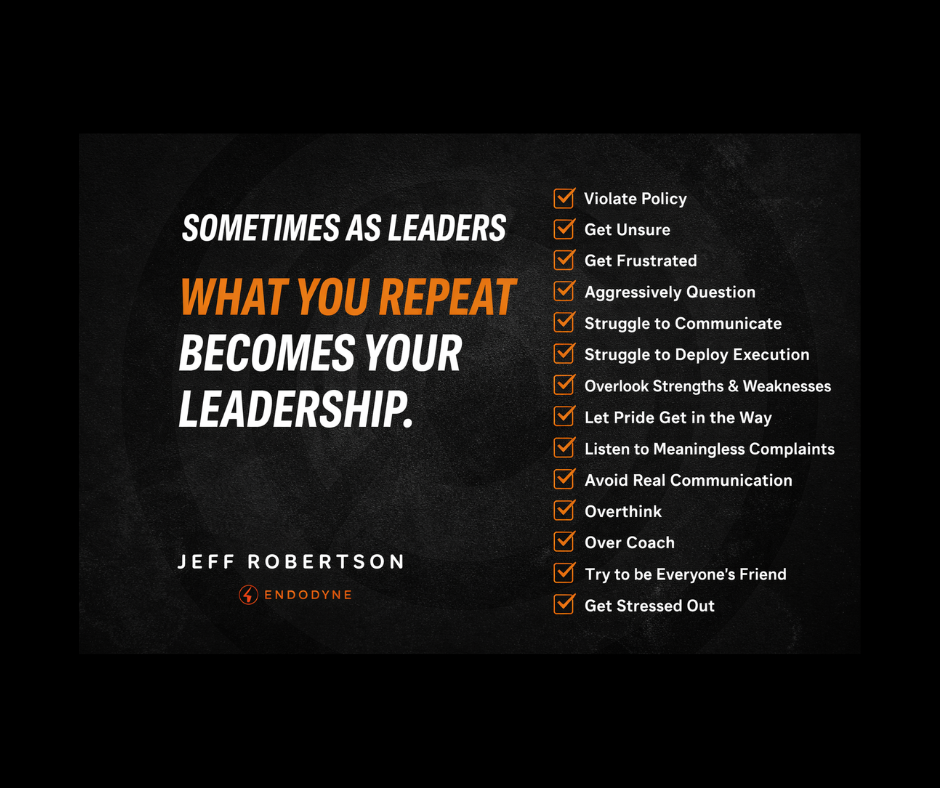
What you repeat becomes your leadership.

These are the patterns that show up on the floor, in the room, and inside your team, whether you realize it or not.


1. We Violate Policy

We bend rules when it’s convenient.

We tell ourselves:

  • Just this once
  • We need to move faster
  • It’ll be fine

But every shortcut sends a message:
Standards are optional.

Leadership isn’t what you say.
It’s what you allow.

Sometimes as Leaders: The Behaviors That Quietly Break Your Team

2. We Get Unsure

We hesitate. We stall. We figure it out.

Your team doesn’t see thoughtfulness.
They feel uncertainty.

Unclear leaders create unclear teams.

Clarity is command.


3. We Get Frustrated

Tone changes. Body language shifts. Patience drops.

You may think you’re hiding it.

You’re not.

Your team mirrors your emotional state.

Calm is leadership.
Frustration spreads faster than any instruction.


4. We Aggressively Question

We push for answers but it comes out sharp.

Instead of curiosity, it feels like confrontation.

People shut down. Communication drops.

Leadership isn’t interrogation.
It’s understanding.


5. We Struggle to Communicate Effectively

We assume people understand.

They don’t.

Instructions are unclear. Expectations are vague.
Execution suffers.

If they don’t execute, it starts with communication.


6. We Struggle to Deploy Execution

We talk about what should happen.

But it never fully lands.

Plans stay in conversation instead of becoming action.

Leadership is not ideas.
It is implementation.


7. We Overlook Strengths and Weaknesses

We treat everyone the same.

But people are not the same.

Some need direction.
Some need space.
Some need clarity.
Some need encouragement.

Leadership is adjustment.

If you don’t see your people, you can’t lead them.


8. We Let Pride Get in the Way

We want to be right.
We want control.
We defend instead of adjust.

Pride blocks growth.

The moment you stop learning, your team stops improving.


9. We Listen to Meaningless Complaints

We give energy to noise.

Instead of solving problems, we reinforce complaining.

What you tolerate grows.

Leaders redirect to solutions.


10. We Avoid Real Communication

We don’t say what needs to be said.

We soften it. Delay it. Avoid it.

Problems grow.

Silence costs more than discomfort.


11. We Overthink

We analyze too long.

We wait for perfect information.

We delay decisions.

Progress dies in hesitation.

Leaders decide and adjust.


12. We Over Coach

We explain too much.

We stay too involved.

We don’t let people own the work.

Over coaching creates dependence.

Leadership develops people. It doesn’t replace them.


13. We Try to Be Everyone’s Friend

We avoid accountability to stay liked.

We let things slide.
We don’t enforce standards.

You might stay liked.
You lose respect.

Leaders are not there to be liked.
They are there to lead.


14. We Get Stressed Out

Pressure shows.

In tone. In decisions. In reactions.

Your team watches everything.

Stress is contagious.
So is composure.


The Real Problem Isn’t These Behaviors

It’s this:

We repeat them.

And what you repeat becomes:

  • your culture
  • your reputation
  • your leadership identity

Endodyne Truth

Leadership doesn’t start with fixing others.

It starts here:

Awareness → Adjustment → Action

You don’t need new tools.
You need cleaner execution of what you already know.


Here’s What to Do Next

Don’t try to fix all of them.

Pick one.

The one that shows up most under pressure.

Then ask:

  • When does it show up?
  • What does my team experience when it does?
  • What will I do differently next shift?

Final Thought

You don’t rise to your intention.

You fall to your patterns.

So control what you repeat.

Your team already feels it, whether you say it or not.

The Daily Reminders I Live By

How to stay grounded, focused and moving forward every single day

People love to complicate life. I don’t. I keep a simple set of reminders that pull me back into who I want to be and how I want to lead. They work anywhere, from the streets of Roanoke to any boardroom, job site or kitchen table across America.

Here’s the breakdown.


Daily Reminders That Keep You Sharp

These are the non negotiables.

  • Live with integrity. Do the right thing even when no one is watching.
  • Love without conditions.
  • Enjoy the small moments. They matter more than the big ones.
  • Count your blessings. Gratitude keeps you hungry and humble.
  • Set big goals. If it doesn’t stretch you, it won’t change you.
  • Act on your dreams. Thinking is cheap. Movement pays.
  • Lift yourself and others. Leaders build leaders.
  • Chase purpose, not noise.

How To Actually Take Care Of Yourself

Most people burn out because they ignore the basics.

  • Sleep. You cannot outwork exhaustion.
  • Give yourself grace. It’s fuel, not weakness.
  • Speak positive truth over yourself.
  • Do things that raise your energy.
  • Journal. Move your body. Breathe.
  • Eat like you respect yourself and hydrate like it’s your job.
  • Work hard but know when to shut it down.
  • Set boundaries with toxic people. Your peace matters.

Who You Should Distance Yourself From

Your circle can either level you up or drag you down. Watch for these types.

  1. People who talk trash about everyone else
  2. People who find a problem for every solution
  3. People who complain like it is a hobby
  4. People who walk around entitled
  5. People who blame others every time they lose
  6. People who take more than they give
  7. People who make you feel small
  8. People who lie or cheat
  9. People who bully or troll
  10. People who nitpick everything

Cut the cord. You cannot grow in polluted soil.


The Reality You Need To Accept

Everyone wants overnight success. That is fantasy land.

  • You will not get stronger overnight
  • You will not get smarter overnight
  • You will not get happier overnight
  • You will not find peace overnight
  • You will not find fulfillment overnight
  • You will not get rich overnight

Growth takes time. Real time. The only shortcut is consistent action.

Stop rushing. Do the work. Stay patient. Let your results catch up.

Jessica Danel: The Chaos, the Comeback, and the Courage to Start Over

Some people tell a story.

Jessica Danel lives one.

In this episode of The Jeff Robertson Show, Jessica brings raw honesty, sharp humor, and hard-earned perspective from a life that has forced reinvention more than once. She built a million-dollar preschool business from scratch, navigated major family and parenting challenges, and rebuilt again through education, career pivots, and storytelling.

This conversation hits home for anyone who has ever carried a lot while trying to keep showing up.


Meet Jessica Danel

Jessica Danel is a wife and mom of three, author of Bucket List from a Redneck Girl, former childcare entrepreneur, and the host of the podcast Just Saying with Jessica Danel.

She built a childcare brand with serious momentum, then made difficult decisions that reshaped everything. Jessica also shares her lived experience with trauma, family pressure, parenting through special needs, and what it takes to keep moving when life refuses to play fair.


What We Cover in This Episode

A childhood shaped by misunderstanding

Jessica opens up about growing up labeled the wrong way, pushed into situations that never fit her reality, and learning early that resilience sometimes starts before you even have words for it.

A near-death car wreck that changed everything

She recounts a drunk-driving crash that ended with her car exploding, and the kind of split-second survival that rewires your view of life.

A community rocked by a high school shooting

Jessica shares the impact of a school shooting connected to her own high school community, and how those moments leave permanent fingerprints on the people who live through them.

Building a preschool empire from the ground up

Jessica explains how she started small, scaled fast, and eventually launched a large facility with major enrollment, major staffing, and major financial pressure.

She also talks through timing, risk, and what it feels like to build something beautiful, then watch outside forces squeeze it.

The hard pivot

A business sale, legal friction, and the emotional fallout pushed Jessica into a new season. She did not stay down. She rebuilt through formal education and career reinvention.

Parenting, special needs, and the daily grind

Jessica shares what it looks like to parent through medical complexity and developmental challenges while still working, still leading, and still trying to keep the family steady.

Writing, podcasting, and turning story into purpose

Her book and podcast give her a platform to tell the truth, laugh at the absurdity, and help others feel less alone.


Why This Episode Matters

Public life and social media love the highlight reel.

Jessica brings the receipts behind the scenes.

This episode speaks to the parent who feels stretched thin, the entrepreneur who took a hit they did not deserve, and the person who knows they need a new chapter but has not found the courage to write it yet.

Jessica proves something simple.

You can rebuild without permission.


Where to Find Jessica Danel


Work With Jeff Robertson

If you want help with leadership, clarity, execution, and building the next version of your life or business, connect here.