RABASONContact

FOR IMMEDIATE RELEASE

Endodyne™ Receives Federal Trademark Protection, Marking a Major Milestone for Leadership Framework Created by Former First Responder Jeff Robertson

VIRGINIA — Endodyne™, the leadership philosophy and decision-making framework created by leadership coach, business strategist, and former first responder Jeff Robertson, has officially received federal trademark protection from the United States Patent and Trademark Office (USPTO).

The trademark represents more than a legal milestone. It marks the formal recognition of a framework that has evolved through decades of real-world leadership, public safety service, entrepreneurship, coaching, and personal rebuilding.

“Endodyne wasn’t created in a boardroom,” said Robertson. “It was built through experience. Through pressure. Through leadership. Through adversity. Through learning what happens when people spend years reacting to life instead of consciously leading it.”

The word Endodyne combines two concepts:

Endo – from within

Dyne – force, energy, movement

Together, Endodyne represents the inner force that moves a person from awareness to action.

At its core, Endodyne teaches that clarity precedes action and that sustainable leadership begins from within.

A Framework for Modern Leaders

Originally developed through Robertson’s work with business owners, leaders, entrepreneurs, and high performers, Endodyne helps people navigate complexity, pressure, uncertainty, and growth by focusing on awareness, alignment, discernment, and purposeful action.

The framework encourages individuals to ask questions such as:

  • What’s got life on it right now?
  • What am I trying to control?
  • What keeps showing up that I need to stop ignoring?
  • What’s one move I can make today?

Rather than promoting hustle, burnout, or endless productivity, Endodyne emphasizes clarity, intentional action, and conscious leadership.

Advancing the Conversation Around Operator Syndrome

Jeff Robertson’s recent work has focused on helping first responders, leaders, business owners, and high performers better understand the long-term effects of living in a constant state of responsibility, readiness, and pressure. Drawing from emerging research surrounding Operator Syndrome, he explores how cumulative stress, hypervigilance, sleep disruption, emotional suppression, and operational tempo can influence leadership, relationships, decision-making, and identity. Rather than focusing solely on pathology or diagnosis, Robertson’s approach centers on awareness, helping people recognize when the skills that once created success may also be creating friction. His message resonates across public safety, business, and leadership communities because it addresses a common challenge: learning how to keep the strengths that helped us succeed without allowing those same adaptations to quietly define who we become.

Built Through Experience

Jeff Robertson‘s background includes service in emergency medical services, law enforcement, undercover narcotics investigations, business ownership, leadership development, and coaching.

Throughout those experiences, he observed a common challenge across professions:

Many capable people become trapped in operating systems that helped them survive but no longer help them thrive.

That observation became a foundational element of Endodyne.

“One of the biggest lessons I’ve learned is that adaptation is automatic, but evolution is intentional,” Robertson said. “Many people spend years reacting to life without ever stopping to examine what has become normal. Endodyne helps people recognize the difference between what is serving them and what is simply familiar.”

Looking Ahead

The federal trademark provides a foundation for continued growth of the Endodyne ecosystem, including:

  • Leadership coaching
  • Workshops and keynote presentations
  • Executive and High Performer development programs
  • Decision-making frameworks
  • Digital learning experiences
  • Leadership content and publications

As organizations continue searching for ways to lead through uncertainty, complexity, and rapid change, Robertson believes the demand for clarity-driven leadership will only continue to grow.

“People don’t need more noise,” Robertson said. “They need more honesty. More awareness. More discernment. They need the ability to recognize what matters, move with confidence, and lead from a place of alignment instead of reaction.”

About Endodyne™

Endodyne™ is a leadership philosophy and operating framework created by Jeff Robertson. Built on the belief that awareness precedes action, Endodyne helps leaders, business owners, and high performers navigate complexity with greater clarity, courage, and intentionality.

For more information, visit:

Media Contact

Jeff Robertson

Lead From Within. Move The World.

Stop Spending Premium Energy on People Who Haven’t Made a Premium Commitment

One of the hardest lessons I’ve learned is that not everyone deserves the same level of access to your time, energy, attention, and expertise.

For years, I treated everyone the same.

I answered the calls.

Returned the messages.

Took the meetings.

Offered the advice.

Solved the problems.

I genuinely wanted to help.

What I eventually discovered was that some people weren’t looking for help.

They were looking for access.

There’s a difference.

When I look at where energy gets wasted, it usually falls into four categories.

1. Free Advice Seekers

These are the people who ask for guidance repeatedly but never implement it.

They schedule meetings.

Send messages.

Ask questions.

Request introductions.

Want your perspective.

Then they do absolutely nothing with it.

The problem isn’t that they need help.

The problem is that they consume energy without creating movement.

At some point, you have to recognize the difference between someone seeking transformation and someone collecting information.

2. Low-Commitment Clients

These are the people who want elite outcomes without elite commitment.

They want championship results.

They want executive performance.

They want high-level coaching.

But they don’t want to invest the time, effort, accountability, or resources required to get there.

They want coaching prices from Walmart and outcomes from Navy SEAL training.

It doesn’t work that way.

Results follow commitment.

Always have. Always will.

3. Chronic Victims

Life hits all of us.

Everyone gets knocked down.

Everyone faces setbacks.

Victims aren’t defined by what happened to them.

They’re defined by their refusal to move beyond it.

These are the people who want sympathy instead of accountability.

Every solution has a reason it won’t work.

Every opportunity has a reason it won’t help.

Every challenge becomes another chapter in the same story.

You can’t coach someone who is more committed to the problem than the solution.

4. Projects That Don’t Scale

Anything that requires you to personally push every button every day eventually becomes a burden.

If your presence is required for every decision, every action, and every outcome, you’ve built a job, not a system.

High performers often fall into this trap because they’re capable.

They can carry more.

Solve more.

Handle more.

The problem is that capability often disguises unsustainability.

The Operator Difference

What’s interesting is that the best operators tend to behave very differently.

Whether we’re talking about military operators, first responders, elite athletes, or high-performing leaders, certain patterns show up repeatedly.

They:

  • Execute
  • Take ownership
  • Value performance
  • Value accountability
  • Seek feedback
  • Adapt quickly
  • Solve problems
  • Carry responsibility

Operators don’t wait for rescue.

They move.

They assess reality and take action.

That’s one reason the Operator Syndrome conversation interests me so much.

The very traits that create extraordinary performance can eventually create extraordinary strain.

Responsibility becomes over-responsibility.

Ownership becomes isolation.

Accountability becomes self-pressure.

Execution becomes exhaustion.

The answer isn’t abandoning those traits.

The answer is becoming selective with where you invest them.

Because premium energy is a finite resource.

And one of the highest forms of leadership is learning where not to spend it.

Not every problem is yours to solve.

Not every person is ready to change.

Not every opportunity deserves your attention.

Protect the source.

Spend your energy where there is movement, ownership, and life.

Everything else is noise.

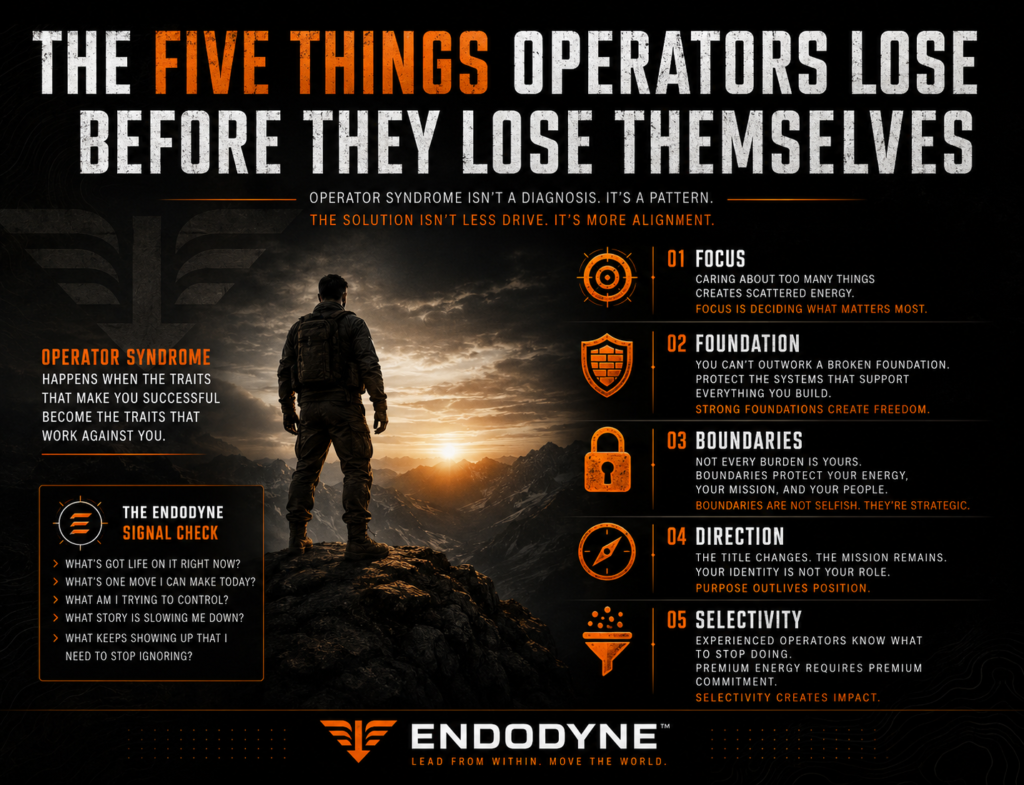
The Five Things Operators Lose Before They Lose Themselves

Most people think burnout happens because someone works too hard.

I don’t buy it.

I’ve met people working eighty-hour weeks who are energized and alive.

I’ve also met people working forty hours a week who feel completely disconnected from themselves.

The difference isn’t workload.

The difference is alignment.

Over the past several years, I’ve become increasingly interested in what happens when high performers begin drifting away from themselves.

First responders.

Military personnel.

Business owners.

Executives.

High Performers.

Leaders.

People who carry responsibility.

People who solve problems.

People who keep moving when everyone else stops.

I’ve started calling this Operator Syndrome.

Operator Syndrome isn’t a diagnosis.

It’s a pattern.

It’s what happens when the traits that make someone successful slowly become the traits that begin to work against them.

The operator keeps pushing.

Keeps carrying.

Keeps producing.

Keeps showing up.

Until one day they realize they’ve become highly effective at everything except listening to themselves.

When I look at people caught in that cycle, I usually see five things disappearing long before the crisis arrives.

1. Focus

Operators rarely fail because they don’t care.

They fail because they care about too many things at once.

Every opportunity looks possible.

Every problem looks solvable.

Every responsibility feels important.

The result is scattered energy.

The operator becomes busy but ineffective.

Movement replaces progress.

Activity replaces direction.

The question isn’t:

“What can I add?”

The question is:

“What deserves my attention right now?”

Focus isn’t about doing more.

Focus is deciding what matters enough to ignore everything else.

2. Foundation

Everyone wants growth.

Nobody wants maintenance.

Then life floods the house.

Sometimes literally.

Foundations aren’t exciting.

Sleep isn’t exciting.

Health isn’t exciting.

Marriage isn’t exciting.

Personal finances aren’t exciting.

Yet every meaningful achievement sits on top of those things.

When foundations weaken, operators usually respond by pushing harder.

That works for a while.

Until it doesn’t.

You can’t outwork a broken foundation forever.

At some point the cracks demand attention.

The strongest leaders I know don’t just build success.

They protect the systems that support success.

The Five Things Operators Lose Before They Lose Themselves

3. Boundaries

Many operators become successful because they say yes.

They help.

They rescue.

They solve.

They sacrifice.

Then they wake up carrying responsibilities that were never theirs to begin with.

One of the hardest lessons in leadership is understanding that not every burden belongs on your back.

Not every emergency is your emergency.

Not every problem requires your involvement.

Not every person deserves unlimited access to your time and energy.

Boundaries are not selfish.

Boundaries protect the mission.

Without boundaries, operators slowly become overwhelmed by obligations that have nothing to do with their purpose.

4. Direction

This may be the biggest challenge facing successful people.

Most people know what they’re doing.

Far fewer know why they’re doing it.

A career becomes an identity.

A title becomes a personality.

A role becomes a prison.

Then something changes.

Retirement.

Divorce.

A business failure.

An injury.

A transition.

A setback.

Suddenly the question appears:

Who am I without the uniform, the title, the company, or the role?

That’s where many operators get stuck.

They know how to perform.

They don’t know how to transition.

Direction comes from understanding that your mission is bigger than your title.

The title changes.

The mission remains.

5. Selectivity

Young operators ask:

“What else can I do?”

Experienced operators ask:

“What should I stop doing?”

This is where wisdom begins.

You don’t build a great life by saying yes to everything.

You build a great life by becoming selective.

Selective with opportunities.

Selective with clients.

Selective with relationships.

Selective with commitments.

Selective with where you spend your energy.

One lesson keeps showing up in my own life:

Stop spending premium energy on people who haven’t made a premium commitment.

That applies to business.

It applies to leadership.

It applies to personal growth.

The people who create extraordinary results usually share a common trait.

They take ownership.

They execute.

They value accountability.

They move when it’s time to move.

The Real Cost of Operator Syndrome

Operator Syndrome isn’t about weakness.

It’s usually the result of strength that has gone unmanaged.

The same drive that creates success can create exhaustion.

The same responsibility that builds trust can create burden.

The same resilience that helps someone survive can prevent them from recognizing when something needs to change.

That’s why I believe the solution isn’t becoming less driven.

The solution is becoming more aligned.

Focus.

Foundation.

Boundaries.

Direction.

Selectivity.

Those aren’t soft skills.

They’re survival skills.

They’re leadership skills.

They’re the difference between building a life and simply enduring one.

The Endodyne Signal Check asks five simple questions:

What’s got life on it right now?

What’s one move I can make today?

What am I trying to control?

What story is slowing me down?

What keeps showing up that I need to stop ignoring?

The answers often reveal more than we expect.

Because the truth is this:

Most operators aren’t lost.

They’re overloaded.

And sometimes the next breakthrough doesn’t come from adding something new.

Sometimes it comes from finally letting go of what no longer belongs.

Endodyne: When Evolution Becomes Conscious

Why High Performers Keep Running Old Programming

By Jeff Robertson

What if the biggest threat to your future isn’t a competitor, a bad economy, artificial intelligence, or a lack of opportunity?

What if it’s your programming?

Not computer programming.

Your programming.

The invisible code running beneath your decisions, relationships, leadership style, habits, and reactions.

The code you didn’t consciously choose.

The code you’ve been executing for years.

The code producing results whether you realize it or not.

This idea has become the foundation of Endodyne, a leadership philosophy and operating system I created after years of studying leadership, recovery, first responders, entrepreneurs, and high performers.

And I believe it points to one of the most important conversations of our time.

The Question That Changed Everything

Years ago, I lost my law enforcement career after a DUI arrest.

At first, I believed the arrest was the problem.

Then I believed alcohol was the problem.

Then I believed stress was the problem.

Over time, I discovered something deeper.

Those were symptoms.

The real issue lived beneath the surface.

The real issue was the operating system that produced those outcomes.

Like many first responders, I spent years functioning in survival mode.

Like many entrepreneurs, I learned how to push harder.

Like many leaders, I learned how to carry more weight.

The problem?

The same operating system that helped me survive eventually started working against me.

I wasn’t examining the code.

I was executing it.

We Are the First Generation Living Inside an Attention Experiment

I grew up as an unattended Super Mario kid.

Many of you did too.

We were the generation that came home from school, grabbed a snack, turned on Nintendo, and disappeared for hours.

No cell phones.

No location tracking.

No constant supervision.

Just kids figuring things out.

At first glance, it seems harmless.

In many ways, it was.

I have great memories of it. My brain was constantly working to save the princess.

But I also think we were part of one of the largest behavioral experiments in human history.

Think about Super Mario.

Jump.

Coin.

Reward.

Jump.

Reward.

Level up.

Reward.

Die.

Restart.

Immediate feedback. Trying to solve the game to win.

Constant stimulation.

Continuous engagement.

Then the games got more sophisticated.

Then came cable television.

Then the internet.

Then smartphones.

Then social media.

Then algorithms specifically designed to capture and hold attention.

Today many people can’t sit quietly for five minutes without reaching for a screen.

Not because they’re weak.

Because they’ve been conditioned.

But I think there’s another layer to this conversation that most people miss.

Technology wasn’t the issue by itself.

The real question is:

What happens when childhood adversity meets unlimited stimulation?

Because not every kid experienced those years the same way.

For one child, video games were entertainment.

For another child dealing with stress, unpredictability, conflict, loneliness, pressure, or emotional neglect, they may have become something else entirely.

They became predictable.

They became controllable.

They became rewarding.

They became an escape.

A place where the rules made sense.

A place where effort produced results.

A place where failure didn’t define you because you could simply hit restart.

When real life feels uncertain, that’s incredibly attractive.

I’m not suggesting video games caused Operator Syndrome.

I’m suggesting they may have amplified coping mechanisms that were already forming.

The child learns:

“When life feels hard, go somewhere else.”

For some people that becomes gaming.

For others it becomes work.

Achievement.

Alcohol.

Social media.

Shopping.

Chaos.

The behavior changes.

The pattern remains.

And that’s where many high performers get stuck.

They’re not necessarily addicted to a thing.

They’re addicted to changing their state.

The Attention Evolution Gap

Here’s what fascinates me.

Human biology evolved over hundreds of thousands of years.

Technology evolved in a few decades.

Our brains still operate on ancient hardware.

Our environment runs modern software.

That gap creates friction.

Your brain evolved to notice movement.

Danger.

Novelty.

Threats.

Opportunity.

Social acceptance.

Now your phone delivers all of those things every few seconds.

Your nervous system never gets a break.

And eventually people mistake stimulation for purpose.

Activity for progress.

Reaction for leadership.

That’s where many high performers get stuck.

The Evolutionary Leap Nobody Talks About

For billions of years, evolution happened automatically.

Life adapted.

Species changed.

Nature selected.

Then something extraordinary happened.

Humans gained the ability to observe themselves.

Not just observe the world.

Observe their own thoughts.

Observe their own beliefs.

Observe their own behavior.

For the first time in Earth’s history, evolution became conscious.

Think about that.

A fish cannot redesign itself.

A deer cannot question its assumptions.

A squirrel cannot challenge its identity.

Humans can.

We can examine the code.

We can rewrite the code.

We can intentionally evolve.

The question is whether we will.

Operator Syndrome: Living on Autopilot

This is where Operator Syndrome (Check out Chris Frueh’s work) enters the conversation.

Operator Syndrome isn’t simply burnout.

It isn’t simply stress.

It isn’t simply trauma.

Operator Syndrome occurs when people spend years operating from inherited programming rather than intentional design.

The symptoms show up everywhere.

In business.

In leadership.

In parenting.

In relationships.

In recovery.

In decision-making.

The person keeps producing outcomes they don’t want.

Yet they keep running the same code.

The result?

More effort.

More frustration.

More confusion.

The same outcomes.

Different day.

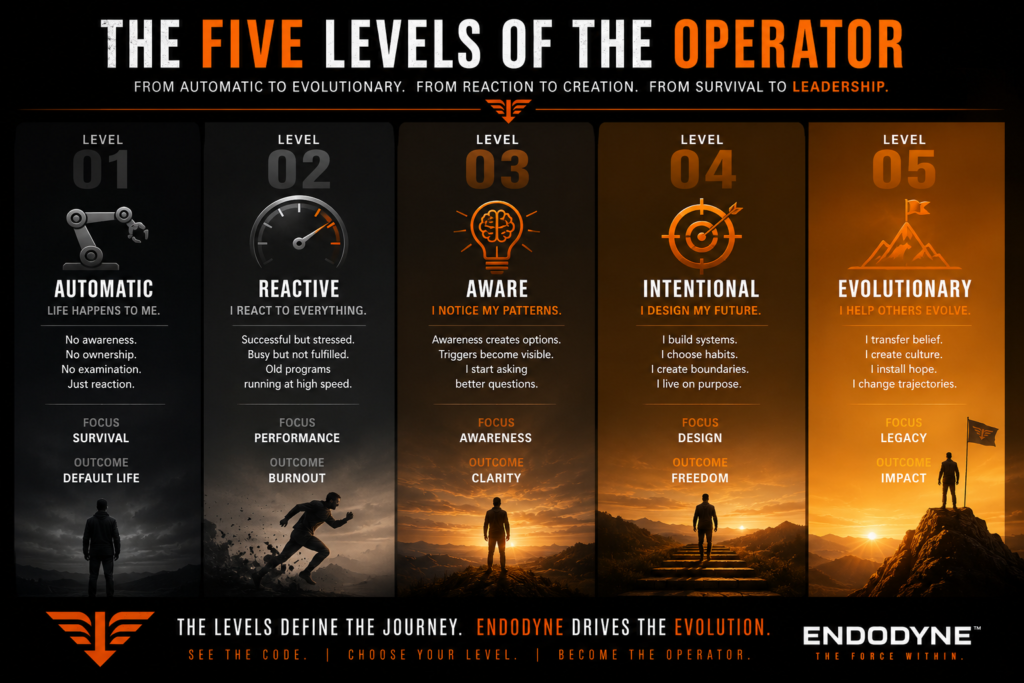
The Five Levels of the Operator

The five levels of the operator

Over the years, I’ve noticed five distinct levels.

Level 1: Automatic

Life happens to me.

No awareness.

No ownership.

No examination.

Level 2: Reactive

The high-performer trap.

Busy.

Driven.

Productive.

Exhausted.

Running old programming at high speed.

Level 3: Aware

The breakthrough.

Patterns become visible.

Triggers become visible.

Beliefs become visible.

Level 4: Intentional

The person begins designing instead of drifting.

Systems replace chaos.

Choices replace reactions.

Level 5: Evolutionary

The person helps others evolve.

This is leadership.

Not title.

Not position.

Transformation.

Why Endodyne Matters

The word Endodyne combines two ideas:

Endo means from within.

Dyne means force or energy.

Endodyne is the force within.

The internal engine that moves someone from awareness into action.

Because awareness alone changes nothing.

You can read every book.

Attend every conference.

Listen to every podcast.

Nothing changes until movement begins.

One of the core principles of Endodyne is simple:

The path confirms itself in motion.

Most people wait for certainty.

Endodyne teaches something different.

Move.

Learn.

Adjust.

Move again.

Truth tends to reveal itself through action.

The Leadership Challenge of the AI Era

Artificial intelligence is changing everything.

But AI isn’t the biggest challenge.

Awareness is.

We have more information than any generation in history.

More tools.

More content.

More options.

More access.

Yet many people feel more disconnected than ever.

Why?

Because information without discernment creates noise.

Endodyne exists to help people separate signal from noise.

To hear themselves clearly.

To stop forcing what is dead.

To move on what is real.

To recognize what keeps showing up.

To stop betraying what they already know.

The future won’t belong to the people with the most information.

The future will belong to the people who can recognize the signal and act on it.

The Endodyne Signal Check

When life gets noisy, ask:

  1. What’s got life on it right now? What feels energized, meaningful, exciting, important, or persistently present in your life right now?
  2. What’s one move I can make today?
  3. What am I trying to control?
  4. What story is slowing me down?
  5. What keeps showing up that I need to stop ignoring?

Those five questions have guided some of the most important decisions of my life.

They continue to guide leaders, entrepreneurs, parents, and high performers who are tired of operating on autopilot.

The Bigger Question

Maybe the most important question isn’t:

“What happened to me?”

Maybe it’s:

“What program produced this outcome?”

Because once you can see the code, you can rewrite it.

Once you can see the pattern, you can interrupt it.

Once you become aware, evolution becomes conscious.

And that may be the greatest leadership opportunity of our time.


About Endodyne

Endodyne is a leadership philosophy created by Jeff Robertson that helps leaders, entrepreneurs, first responders, and high performers recognize the programming driving their decisions, separate signal from noise, and lead from clarity instead of survival mode.

Lead from within. Move the world.

Identity Loss After Retirement: Lessons from a Retired FBI Agent

What happens when the badge comes off?

That question sits at the heart of my recent conversation with retired FBI Special Agent Eric Robinson.

Eric spent 12 years as a Baptist minister before beginning a 24-year career in the FBI. During that time, he worked drug investigations, gangs, crimes against children, counterterrorism, white-collar crime, and served 15 years as a SWAT operator.

Most people hear that story and focus on the investigations.

I focused on something else.

Identity.

Because whether you’re a police officer, firefighter, military operator, business owner, executive, coach, or entrepreneur, the same challenge eventually arrives:

Who are you when the role no longer defines you?

Why Retirement Hits High Performers Differently

Most retirement advice focuses on money.

Very little focuses on identity.

For high performers, the career often becomes more than a paycheck. It becomes purpose. It becomes community. It becomes status. It becomes routine. It becomes part of who you believe you are.

For decades, Eric was the guy people called when things went wrong.

The FBI agent.

The SWAT operator.

The problem solver.

Then one day, retirement arrives.

The phone stops ringing.

The missions stop coming.

The role disappears.

Many operators discover they never prepared for that transition.

Watch the full episode

When Service Becomes Identity

One of the most powerful moments in our conversation came when Eric reflected on retirement.

He said:

“Being that guy was such a thrill. But being that guy was also such a burden.”

That statement captures something many first responders never say out loud.

The job gives you purpose.

The job gives you belonging.

The job gives you meaning.

But the job also demands a price.

Years of hypervigilance.

Years of stress.

Years of exposure to trauma.

Years of carrying burdens most people never see.

Eventually, many operators struggle to separate who they are from what they do.

That’s where the danger begins.

The Hidden Cost of Living in Service Mode

Before joining the FBI, Eric planted a church focused on outreach and grace.

By every traditional measure, the ministry was succeeding.

People were coming.

Lives were changing.

The mission was working.

Yet for two years, Eric suffered daily stress headaches.

Every day.

The problem wasn’t failure.

The problem was carrying everyone else’s problems as his own.

Many first responders face the same challenge.

Many business owners face the same challenge.

Many leaders face the same challenge.

They become so committed to helping others that they lose the ability to separate their responsibility from someone else’s burden.

The result often looks like chronic stress, burnout, exhaustion, anxiety, depression, or what many in tactical communities now recognize as Operator Syndrome.

What First Responders Can Learn From This

One lesson stood out throughout our conversation.

Compassion and strength are not opposites.

Eric discovered that many of the same skills that helped him in ministry also helped him inside the FBI.

Curiosity.

Empathy.

Listening.

Human connection.

He wasn’t successful because he became harder.

He became successful because he understood people.

That distinction matters.

Many operators believe survival requires emotional shutdown.

In reality, long-term resilience often requires emotional awareness.

The strongest people aren’t always the toughest.

They’re often the most self-aware.

The Identity Transfer Framework

One pattern I’ve observed repeatedly among law enforcement officers, firefighters, military veterans, and high performers is what I call the Identity Transfer Framework.

Stage 1: The Mission

The role becomes the purpose.

The badge.

The business.

The rank.

The title.

The identity becomes fused to performance.

Stage 2: The Loss

Retirement.

Career change.

Injury.

Termination.

Life transition.

Something removes the role.

Many people experience confusion, anger, depression, or a loss of direction during this stage.

Stage 3: The Transfer

The healthiest people learn to transfer purpose instead of chasing the past.

They stop trying to relive who they were.

They build who they are becoming.

This is where many people get stuck.

Not because they lack ability.

Because they cannot let go of the old identity.

What Happens When the Badge Comes Off?

The answer depends on whether you built your life around a role or around a purpose.

A role eventually ends.

A purpose evolves.

Eric no longer carries an FBI credential every day.

He no longer deploys with a SWAT team.

He no longer receives operational calls in the middle of the night.

But he still serves.

Today, that service looks different.

He’s writing.

Teaching.

Sharing stories.

Helping others learn from his experiences.

The mission changed.

The purpose remained.

The Real Lesson

The conversation wasn’t really about the FBI.

It wasn’t about SWAT.

It wasn’t about ministry.

It was about learning how to move into the next chapter without dragging the old uniform behind you.

That lesson applies to every high performer.

Every leader.

Every business owner.

Every parent.

Every person standing at a transition point wondering what’s next.

The Endodyne Signal Check

If you’re facing a major transition, ask yourself:

  • What part of my identity am I afraid to release?
  • What role am I trying to hold onto?
  • What purpose exists beneath that role?
  • What keeps showing up that I need to stop ignoring?
  • What’s one move I can make toward the next chapter?

The path rarely becomes clear while standing still.

The path confirms itself in motion.

Listen to the Full Conversation

In my conversation with Eric Robinson, we discuss:

  • Leaving ministry and joining the FBI
  • Managing stress and burnout
  • Compassion as a tactical advantage
  • Life on SWAT
  • Identity after retirement
  • Leadership lessons from high-stakes environments
  • His upcoming book, Irreverend: From Saving Souls to Chasing Sinners in the FBI

Because eventually, every high performer faces the same question:

Who are you when the badge comes off?

Operator Syndrome: What If PTSD Is Only Part of the Story?

A Public Safety Perspective on Stress, Survival, and the Hidden Wear Operators Carry

For years, I told people:

“I don’t think I have PTSD, but I know something isn’t operating right.”

I wasn’t denying stress.

I wasn’t pretending difficult experiences hadn’t happened.

I just never felt like the traditional PTSD conversation fully explained what I was seeing in myself and in many others throughout public safety.

Then I started studying the Operator Syndrome framework.

What caught my attention wasn’t the discussion around trauma.

It was the discussion around cumulative wear.

Because if you’ve spent enough years in EMS, law enforcement, fire rescue, military service, corrections, or emergency communications, you know something important:

Not everyone who struggles is falling apart emotionally.

Many are still functioning at a very high level.

They’re showing up.
Performing.
Leading.
Solving problems.
Handling crises.

Yet something underneath keeps deteriorating.

The Public Safety Trap

One thing I’ve observed throughout my career is that public safety offers an easy place to hide.

Not because people are weak.

Because the mission never stops.

There is always another call.
Another emergency.
Another victim.
Another crisis.

As long as you’re helping someone else, you don’t have to spend much time examining yourself.

Many first responders become incredibly skilled at carrying other people’s problems.

The danger comes when that becomes the only thing they know how to do.

Years pass.

Stress accumulates.

Relationships suffer.

Sleep deteriorates.

Health declines.

Yet they keep functioning.

In many cases, the people struggling the most still look like the strongest people in the room.

What If PTSD Isn’t The Entire Picture?

One of the most thought-provoking aspects of the Operator Syndrome framework is the idea that some operators may be experiencing something broader than traditional psychiatric explanations alone.

The conversation shifts from:

“What’s wrong with you?”

to

“What has happened to your system after years of exposure?”

That’s a very different question.

Because many operators and first responders spend years exposed to:

  • sleep disruption
  • chronic stress
  • traumatic incidents
  • hypervigilance
  • shift work
  • physical injuries
  • emotional suppression
  • operational pressure
  • cumulative stress exposure

Eventually the body adapts.

The nervous system adapts.

The brain adapts.

The question becomes whether those adaptations come with a cost.

Understanding Allostatic Load

One of the key concepts behind Operator Syndrome is allostatic load.

Simply put, allostatic load refers to the cumulative wear and tear that chronic stress places on the body and nervous system.

Most people understand stress as an event.

Operators understand stress as a lifestyle.

A difficult call creates stress.

Years of difficult calls create accumulation.

A sleepless night creates fatigue.

Years of disrupted sleep create consequences.

One traumatic event can be significant.

Thousands of stressful exposures over a career can reshape how a person operates.

That accumulated burden matters.

The Hidden Physical Side Of The Conversation

For years, many discussions focused almost exclusively on mental health symptoms.

Operator Syndrome broadens the conversation.

It asks us to consider factors such as:

  • traumatic brain injury
  • endocrine dysfunction
  • hormonal imbalances
  • chronic inflammation
  • sleep deprivation
  • neurological stress
  • physical injuries
  • metabolic health

In other words:

What if some symptoms commonly attributed entirely to mental health challenges are also connected to physical systems under years of operational strain?

That question deserves attention.

Why Sleep Matters More Than Most People Realize

Ask almost any veteran first responder about sleep and you’ll likely get a knowing smile.

Shift work.
Overnight calls.
Rotating schedules.
Adrenaline spikes.

Sleep often becomes the first casualty of operational life.

The problem is that poor sleep affects everything:

  • mood
  • decision-making
  • emotional regulation
  • memory
  • recovery
  • hormones
  • physical health

Many operators spend years treating sleep deprivation as normal.

The body keeps score anyway.

The Cost Of Compartmentalization

Public safety culture often rewards compartmentalization.

You handle the call.

You move to the next one.

You stay composed.

You keep functioning.

Those skills are necessary.

They help people survive difficult careers.

But problems arise when compartmentalization becomes the only coping strategy available.

Pain doesn’t disappear because it gets ignored.

It accumulates.

Grief accumulates.

Stress accumulates.

Exhaustion accumulates.

Eventually something demands attention.

When The Mission Becomes Identity

This may be one of the most important conversations of all.

Many operators become deeply connected to the mission.

Helping people becomes identity.

Solving problems becomes identity.

Being needed becomes identity.

Being useful becomes identity.

The mission provides meaning.

But it can also become a place to hide.

When that happens, retirement becomes difficult.

Transitions become difficult.

Relationships become difficult.

Stillness becomes difficult.

Because many operators know exactly who they are during the mission.

They struggle to answer the question:

“Who am I when the mission ends?”

Recovery Is Bigger Than Treatment

One of the most valuable lessons I’ve taken from studying Operator Syndrome is that recovery may require a broader approach than many people realize.

Recovery might involve:

  • improving sleep
  • addressing physical injuries
  • evaluating hormonal health
  • reducing chronic stress load
  • rebuilding relationships
  • improving physical fitness
  • finding purpose outside the mission
  • developing self-awareness
  • reconnecting with identity beyond performance

None of these replace mental health support.

But they remind us that human beings are systems.

Not checklists.

The Question More Operators Need To Ask

For years I assumed some of my patterns were simply personality.

I thought I was wired differently.

Maybe I was.

But I also learned something else.

Sometimes what we call personality is adaptation.

Sometimes what we call toughness is accumulated stress.

Sometimes what we call drive is survival.

And sometimes the strongest people in the room have simply become experts at carrying more than anyone realizes.

The goal isn’t weakness.

The goal isn’t becoming less resilient.

The goal is awareness.

Because awareness gives us options.

And for many operators, first responders, and high performers, awareness may be the first step toward understanding what years of service have truly cost them.

Operator Syndrome, PTSD, and the Public Safety Trap

What A Question posed 20 Years ago Helped Me Finally Understand

For years, I told people:

“I don’t think I have PTSD, but I know something in me isn’t operating normally.”

That sentence sat in my head for a long time.

Not because I was denying stress or pressure.
Not because I thought I was invincible.

I just didn’t fully connect with the framework I kept hearing.

Then I started reading the work of psychologist and researcher Chris Frueh and his book Operator Syndrome.

And honestly, a lot of things finally started connecting.

Not just for military operators.
For many people in public safety too.

Operator Syndrome Is Bigger Than PTSD Alone

One of the things Frueh argues throughout his work is that many operators may be experiencing something much broader than traditional psychiatric framing alone.

Not simply:

  • fear-based trauma
  • emotional injury
  • PTSD in isolation

But cumulative:

  • physiological wear
  • neurological stress
  • endocrine dysfunction
  • nervous system overload
  • chronic sleep disruption
  • blast exposure
  • hypervigilance
  • operational tempo
  • compartmentalized pain
  • identity fusion with mission

He repeatedly discusses:

allostatic load

Which refers to the cumulative burden chronic stress places on the body and nervous system over time.

That matters.

Because a lot of operators and first responders do not necessarily present like traditional PTSD stereotypes people imagine.

Many remain:

  • highly functional
  • mission-focused
  • productive
  • calm under pressure
  • capable
  • operationally effective

while quietly deteriorating underneath.

Public Safety Has Its Own Version of This

I’m not trying to relabel public safety as military special operations.

But I do believe many people in EMS, law enforcement, fire rescue, corrections, dispatch, and emergency communications will recognize pieces of this framework immediately.

Especially this part:

compartmentalizing pain through the mission.

One thing I’ve seen repeatedly throughout my own career is this:

A lot of people in public safety learn how to hide inside other people’s problems.

There is always another call.
Another emergency.
Another victim.
Another overdose.
Another wreck.
Another crisis demanding your attention.

As long as you stay moving, you do not have to fully sit with yourself.

The job rewards that.

In fact, many times the people falling apart internally are still viewed as:

  • reliable
  • strong
  • productive
  • composed
  • committed

because operational culture rewards functionality.

That is part of why these conversations are difficult.

My Childhood Didn’t Create Operator Syndrome

My childhood did not create Operator Syndrome.

But the environment I grew up in absolutely conditioned me in ways that made operational environments feel familiar later.

Pressure already felt normal to me.
Chaos already felt normal.
Hyper-awareness already felt normal.
Emotional suppression already felt normal.

Then I entered professions that rewarded those adaptations.

EMS rewarded calm during emergencies.
Law enforcement rewarded hypervigilance.
Undercover work rewarded compartmentalization, observation, emotional control, and constant awareness.

The environment amplified patterns that already existed inside me until eventually the system itself started breaking down.

That distinction matters.

The “Never Quit” Culture

Operators and high performers often become extremely skilled at:

  • pushing through exhaustion
  • ignoring injuries
  • suppressing emotions
  • overriding stress
  • staying mission-focused regardless of personal cost

Public safety culture mirrors that in many ways.

You learn:

  • keep moving
  • keep functioning
  • handle the call
  • suppress emotion
  • stay composed
  • get through the shift

And after enough years, many people no longer know how to separate:

  • identity
    from
  • performance.

That becomes dangerous.

Why Some Public Safety Professionals Struggle With Traditional Counseling

This is another uncomfortable conversation that needs honesty.

Many public safety professionals quietly struggle to connect with counseling environments where the practitioner has no lived operational experience.

That does NOT mean therapists are bad.
It does NOT mean counseling cannot help.
And it does NOT mean mental health care is unnecessary.

But operational cultures carry:

  • dark humor
  • compartmentalization
  • adrenaline conditioning
  • constant exposure to suffering
  • emotional suppression
  • hypervigilance
  • identity through usefulness
  • mission-first thinking

People who have lived inside those environments often communicate differently because the job changes how people process stress and emotion.

That gap can create frustration when operators or first responders feel like they are being reduced to:

  • diagnostic checklists
  • medication conversations
  • psychiatric labels

instead of being understood as whole human beings shaped by cumulative operational exposure.

Criticism of the Current System

One thing I respect about Frueh’s work is that he challenges overly narrow psychiatric framing without pretending mental health concerns are fake.

That distinction matters.

He argues the current system often emphasizes:

  • psychiatric diagnoses
  • medication
  • symptom labeling

while overlooking:

  • endocrine issues
  • neurological stress
  • sleep dysfunction
  • blast exposure
  • chronic physiological wear
  • nervous system overload
  • social isolation
  • identity disruption

He also raises difficult questions about whether some systems unintentionally reinforce chronic disability identities instead of focusing on whole-person restoration.

That conversation will make some people uncomfortable.

But uncomfortable conversations are often where growth starts.

Awareness Matters

Operator Syndrome helped me better understand parts of my own life and career that I could never fully explain before.

Not weakness.
Not failure.

Conditioning.
Accumulation.
Adaptation.
Operational wear.

And honestly, I think many people in public safety quietly recognize this in themselves.

The inability to fully slow down.
The need for constant movement.
The discomfort with peace.
The pressure normalization.
The emotional compartmentalization.
The identity tied to usefulness.

For years, I thought:

“This is just who I am.”

Now I understand more clearly that sometimes survival adaptations become identity if you never step back long enough to examine them.

The Goal Is Not Weakness

This conversation is not about making operators soft.

It is not about removing accountability.
It is not about avoiding responsibility.
It is not about abandoning resilience.

The goal is awareness.

Because awareness creates options.

And many high performers spend years functioning inside systems they never fully stop to examine until something finally breaks.

That’s why these conversations matter.

The Rise of Narrative-Led Attention Marketing: Why Personality Is Beating Traditional Branding

For years, businesses focused on polished branding, perfect messaging, and carefully controlled marketing campaigns.

That world is changing fast.

Today, attention moves differently. Algorithms reward emotion, consistency, recognizable personalities, and ongoing stories more than polished corporate messaging. The businesses, creators, and public figures winning online understand one thing:

They are no longer just selling products or services.

They are building media ecosystems around human identity.

This shift explains the rise of influencer-driven politics, creator-led businesses, and personality-first brands. It also explains why some companies dominate attention online while others struggle despite having better products.

The strategy behind this movement has a name:

Narrative-Led Attention Marketing

This approach combines storytelling, personality, emotional connection, and continuous content creation into a modern media strategy built for today’s algorithms and audience behavior.

The goal is simple:

Become impossible to ignore.


The Death of Traditional “Safe” Marketing

Traditional business marketing often looks like this:

  • polished stock photos
  • generic value propositions
  • heavily filtered messaging
  • carefully scripted videos
  • safe corporate language
  • infrequent posting
  • transactional advertising

The problem is simple.

Most of it feels emotionally empty.

Modern audiences spend hours every day consuming creator content, podcasts, livestreams, short-form video, and behind-the-scenes storytelling. They now compare every business message against creators who feel human, immediate, and emotionally real.

That changes expectations.

People no longer just buy products.

They buy:

  • perspective
  • personality
  • trust
  • familiarity
  • emotional alignment
  • leadership
  • ongoing narrative

This is why personality-driven brands continue gaining ground across industries.


What Is Narrative-Led Attention Marketing?

Narrative-Led Attention Marketing turns a business, founder, creator, or leader into an ongoing media story.

Instead of only marketing outcomes, the business markets:

  • the journey
  • the decisions
  • the setbacks
  • the lessons
  • the mission
  • the emotional reality behind the work

This creates audience investment.

The audience no longer feels like spectators.

They feel involved.

That emotional involvement creates stronger:

  • engagement
  • retention
  • trust
  • referrals
  • repeat exposure
  • brand recall

Why This Strategy Works So Well Right Now

Modern platforms reward behavior that keeps people watching, commenting, sharing, and reacting.

Algorithms prioritize:

  • recognizable personalities
  • emotional reactions
  • recurring themes
  • conflict and tension
  • direct camera communication
  • serialized storytelling
  • community participation

This creates a massive advantage for businesses and leaders willing to show:

  • perspective
  • conviction
  • vulnerability
  • process
  • behind-the-scenes thinking

The companies winning attention today often operate more like media companies than traditional businesses.

That shift matters.


The Core Components of Narrative-Led Attention Marketing

1. Personality Over Perfection

People trust humans faster than logos.

The strongest brands today often feature:

  • founder visibility
  • direct communication
  • recognizable voice
  • authentic reactions
  • consistent opinions
  • human moments

This does not mean unprofessional.

It means emotionally recognizable.


2. Story Over Static Content

Most businesses post disconnected content pieces.

High-performing creators build ongoing storylines.

Examples include:

  • rebuilding after setbacks
  • scaling a business
  • solving customer problems publicly
  • documenting lessons learned
  • showing operational reality
  • sharing wins and failures in real time

The audience returns because the story continues.


3. Frequency Creates Familiarity

Most businesses disappear between marketing campaigns.

Narrative-led brands stay visible consistently.

Visibility compounds trust.

People rarely buy from strangers immediately. They buy after repeated exposure and emotional familiarity.

That means consistent content matters more than occasional “perfect” campaigns.


4. Emotional Relevance Beats Information Density

Many businesses overload audiences with information.

Modern attention favors emotional clarity.

Strong content often triggers:

  • curiosity
  • tension
  • inspiration
  • frustration
  • hope
  • identification
  • urgency

Emotion creates memory.

Memory creates attention.

Attention creates opportunity.


5. Every Event Becomes Content

Narrative-led marketers understand that:

  • challenges become lessons
  • customer conversations become insights
  • setbacks become stories
  • market shifts become commentary
  • behind-the-scenes moments become trust builders

This creates an endless content engine.


Why Businesses Must “Own Their Own Media”

Platforms change constantly.

Algorithms shift.
Search evolves.
Advertising costs rise.
Organic reach fluctuates.

Businesses that depend entirely on rented platforms stay vulnerable.

Owning your own media means building:

  • direct audience relationships
  • email lists
  • podcasts
  • websites
  • communities
  • searchable authority
  • recognizable personal brands

The future belongs to businesses that act like publishers, educators, and storytellers instead of relying only on traditional advertising.


The Danger of Copying the Wrong Part

Many people misunderstand this strategy.

They copy:

  • outrage
  • controversy
  • chaos
  • fake authenticity
  • nonstop emotional manipulation

That creates temporary spikes but weak long-term trust.

The real opportunity sits elsewhere.

The businesses that dominate long-term will combine:

  • strong operational competence
  • clear expertise
  • real leadership
  • strategic storytelling
  • consistent visibility

Attention without substance collapses.

Substance without visibility gets ignored.

The future belongs to businesses that combine both.


What Smart Business Owners Should Do Next

Start thinking like a media company.

That does not mean becoming an entertainer.

It means becoming visible, recognizable, and narratively consistent.

Here’s what to do next:

Show Your Thinking

Explain:

  • decisions
  • observations
  • lessons
  • operational realities
  • customer patterns
  • market changes

People follow leaders who help them understand the world.


Build Repeatable Themes

Strong media brands repeat recognizable ideas.

Examples:

  • financial clarity
  • leadership under pressure
  • operational discipline
  • growth strategy
  • local business insights
  • AI implementation
  • overcoming setbacks

Repetition builds identity.


Document Instead of Constantly Creating

You do not need endless polished productions.

Document:

  • meetings
  • lessons
  • wins
  • struggles
  • ideas
  • process
  • conversations

Reality often performs better than perfection.


Become Consistently Visible

Modern trust comes from repeated exposure.

Not occasional appearances.

Consistency beats intensity.


The Bottom Line

The businesses winning modern attention are not simply “doing marketing better.”

They understand something bigger:

The internet now rewards ongoing human narratives more than polished corporate messaging.

The future belongs to leaders and companies willing to:

  • own their own media
  • build recognizable identity
  • communicate consistently
  • create emotional relevance
  • turn expertise into ongoing storytelling

Because in today’s attention economy, the most valuable asset is no longer just the product.

It is the relationship people build with the story behind it.


For more leadership, AI, business growth, and modern media strategy insights, visit Jeffrey Robertson

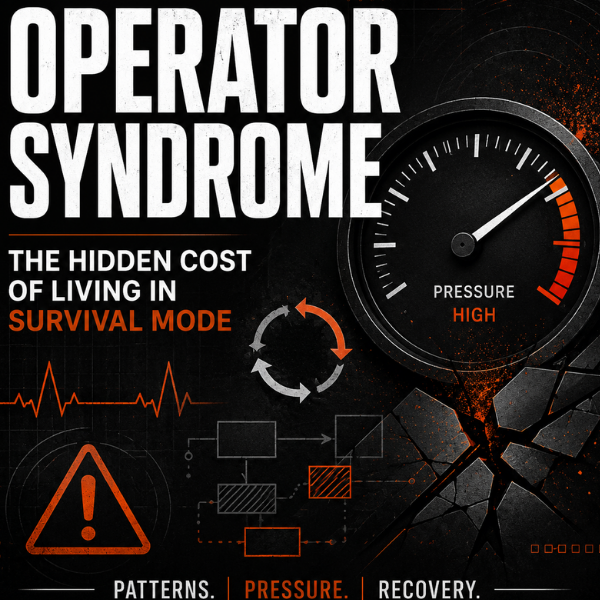
Operator Syndrome: The Hidden Cost of Living in Survival Mode

What Is Operator Syndrome?

Operator Syndrome is a term increasingly used to describe the long-term mental, emotional, physical, and behavioral effects of prolonged exposure to high-stress operational environments.

The concept gained wider attention through research from psychologist and trauma researcher Chris Frueh, who studied military special operations personnel and the cumulative impact of chronic operational stress.

At its core, Operator Syndrome describes what happens when years of:

  • hypervigilance
  • pressure
  • readiness
  • emotional suppression
  • adrenaline exposure
  • responsibility
  • trauma exposure
  • mission-first thinking reshape the way a person thinks, reacts, communicates, and lives.

Operator Syndrome is not officially classified as a standalone medical diagnosis.

It is better understood as a pattern of operational conditioning and accumulated stress adaptation.

And while the original research focused heavily on military operators, many of the same patterns appear in:

  • law enforcement
  • EMS
  • firefighters
  • healthcare professionals
  • executives
  • entrepreneurs
  • high-pressure leadership environments

Because pressure changes people.

My Personal Experience With Operator Syndrome

I didn’t discover the concept of Operator Syndrome inside a classroom.

I recognized parts of myself in it.

Long before I entered law enforcement, EMS, or undercover work, my nervous system had already learned survival early.

I grew up around adversity.

Especially on a kid.

At 15 years old, I entered EMS.

Most teenagers are still learning who they are.

I stepped directly into:

  • emergencies
  • death
  • chaos
  • adrenaline
  • crisis environments
  • responsibility under pressure

before adulthood fully formed.

Then came:

  • EMS
  • 911 environments
  • police work
  • undercover operations
  • leadership under pressure
  • entrepreneurship
  • rebuilding after mistakes
  • identity shifts across multiple seasons of life

For years, I said something many operators understand immediately:

“I never felt like I earned the title PTSD… but I knew something changed in me.”

That tension matters.

Because many people experiencing Operator Syndrome still function at high levels.

They still:

  • work
  • lead
  • provide
  • perform
  • solve problems
  • carry responsibility

From the outside, they often look disciplined and highly capable.

Internally, many feel:

  • constantly “on”
  • emotionally armored
  • unable to fully relax
  • restless without pressure
  • hyperaware of everything around them
  • disconnected from calm

That does not automatically mean someone is broken.

It often means they adapted to prolonged pressure.

Common Symptoms of Operator Syndrome

Operator Syndrome can affect multiple areas of life simultaneously.

Research surrounding the concept often discusses patterns involving:

  • sleep disturbance
  • chronic hypervigilance
  • anger
  • anxiety
  • depression
  • emotional detachment
  • cognitive fatigue
  • concentration problems
  • identity disruption
  • relationship strain
  • transition difficulties after operational careers
  • loss of purpose outside mission environments

Many operators also experience what researchers call allostatic load.

Allostatic load refers to the accumulated wear and tear on the body and nervous system caused by chronic stress exposure over time.

Translated simply:

Years of pressure reshape people physically and psychologically.

Operator Syndrome and Leadership

One reason Operator Syndrome matters outside military and first responder communities is because the same survival patterns often appear in leadership environments.

The nervous system does not care about job titles.

An entrepreneur carrying payroll…
A police supervisor managing crises…
A founder under constant pressure…
A healthcare leader responsible for lives…

Different environments.

Same human stress systems.

That is why many executives and high performers display patterns similar to operational personnel:

  • inability to power down
  • emotional suppression
  • overcontrol
  • hypervigilance
  • reactive communication
  • identity tied entirely to usefulness

The same conditioning that helps people survive pressure can quietly damage leadership if left unmanaged.

Awareness Versus Hypervigilance

One of the most important distinctions inside the Operator Syndrome conversation is the difference between awareness and hypervigilance.

Awareness says:

“I can respond if necessary.”

Hypervigilance says:

“I must constantly prepare for danger.”

One creates clarity.

One creates exhaustion.

Many high performers become so conditioned to stress and readiness that calm starts feeling unfamiliar.

Some even create unnecessary tension because the nervous system becomes accustomed to stimulation and pressure.

That affects:

  • leadership
  • relationships
  • parenting
  • communication
  • emotional availability
  • long-term health

The Hidden Cost of Constant Readiness

Operator Syndrome often hides behind competence.

Society rewards people who:

  • stay composed
  • sacrifice constantly
  • work relentlessly
  • solve problems quickly
  • remain emotionally controlled under pressure

But eventually the internal cost appears:

  • burnout
  • emotional numbness
  • relationship strain
  • identity loss
  • exhaustion
  • disconnection from purpose
  • difficulty transitioning outside operational environments

Many operators eventually realize they feel more comfortable inside chaos than calm.

That realization can be difficult to face.

Especially after:

  • retirement
  • career transition
  • divorce
  • burnout
  • loss of mission
  • rebuilding seasons

Because eventually a hard question appears:

“Who am I when nobody needs me in crisis mode?”

How To Recover From Survival-Mode Leadership

The answer is not becoming soft.

The answer is regaining conscious control over the internal operating system driving behavior, leadership, communication, and identity.

That starts with:

  • awareness
  • honest self-reflection
  • emotional regulation
  • nervous system recovery
  • rebuilding identity outside performance
  • reconnecting to purpose intentionally
  • separating useful adaptations from unnecessary activation

The traits that help people survive one season can quietly damage the next season if left unexamined.

That does not make someone weak.

It makes them conditioned.

And conditioning can be understood, adjusted, and redirected.

Why the Operator Syndrome Conversation Matters

The conversation around Operator Syndrome matters because many high performers do not recognize what prolonged pressure has done internally.

They simply normalize it.

Especially inside:

  • public safety culture
  • military environments
  • executive leadership
  • entrepreneurship
  • high-performance careers

But awareness changes things.

Because once people recognize the pattern, they can begin rebuilding intentionally instead of remaining trapped in permanent survival mode.

And that may be the next level of leadership.

Operator Syndrome Interview: Signs, Symptoms, Recognition, and Recovery

A Conversation with Jeff Robertson


What Is Operator Syndrome?

Interviewer:

The phrase Operator Syndrome has started showing up more often in leadership, military, and first responder conversations. What does it actually mean?

Jeff Robertson:

Operator Syndrome is a term increasingly used to describe the long-term effects of prolonged exposure to high-stress operational environments.

The concept gained attention through research involving military special operations personnel, particularly the work of psychologist and trauma researcher Chris Frueh.

At its core, Operator Syndrome describes what happens when years of:

  • hypervigilance
  • pressure
  • emotional suppression
  • readiness
  • responsibility
  • trauma exposure
  • mission-first thinking begin shaping how a person thinks, reacts, communicates, and lives.

It’s important to understand that Operator Syndrome is not currently an official standalone diagnosis.

It’s more of a framework for understanding operational conditioning and cumulative stress adaptation.

And honestly, it applies far beyond military operators.

You see similar patterns in:

  • law enforcement
  • EMS
  • firefighters
  • healthcare professionals
  • executives
  • entrepreneurs
  • high-pressure leadership environments

Because pressure changes people.

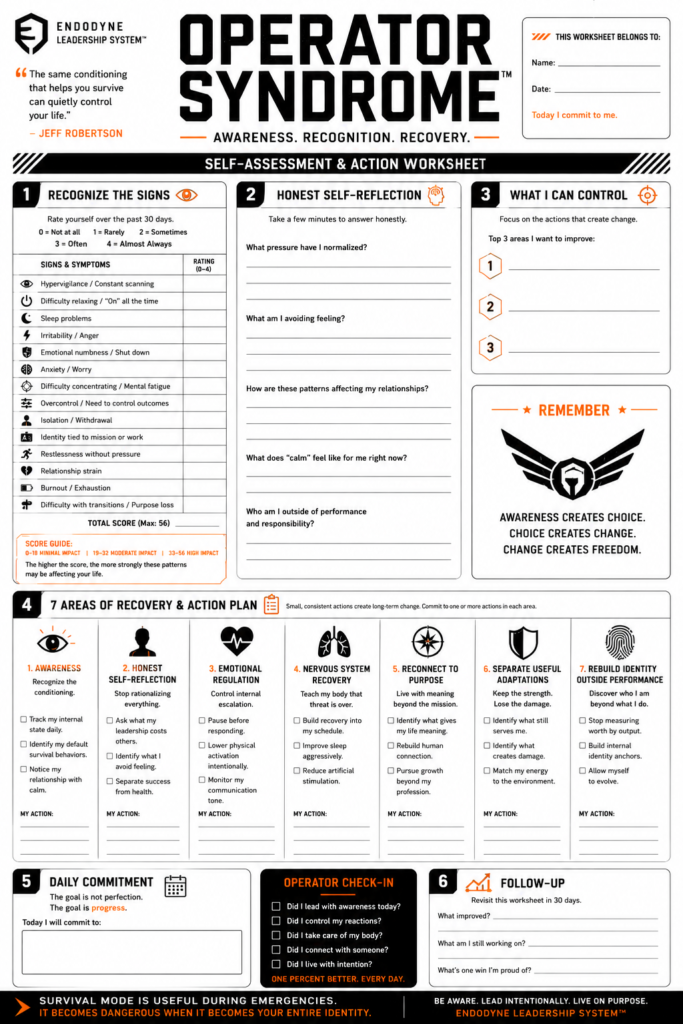
Operator Syndrome Worksheet

When Did You First Recognize It in Yourself?

Interviewer:

What made the concept resonate with you personally?

Jeff Robertson:

For years, I said something that a lot of operators immediately understand:

“I never felt like I earned the title PTSD… but I knew something changed in me.”

That’s the tension many people live with.

They still function.
Still work.
Still lead.
Still provide.
Still perform under pressure.

But internally, they know something shifted.

For me, operational conditioning probably started before the professions themselves.

I grew up around adversity early.

As a kid, I found a close relative after they passed away. The same day, I experienced something I still struggle to fully explain rationally. Experiences like that leave a mark on a young nervous system.

Then I entered EMS at 15 years old.

Most teenagers are still figuring out identity and life.

I stepped into:

  • emergencies
  • death
  • adrenaline
  • chaos
  • crisis environments
  • responsibility under pressure

before adulthood fully formed.

Then came:

  • EMS
  • 911 environments
  • law enforcement
  • undercover work
  • leadership pressure
  • entrepreneurship
  • rebuilding seasons after mistakes

Eventually pressure stopped feeling abnormal.

Calm did.

That’s when many people realize something deeper is happening internally.


What Are the Common Signs of Operator Syndrome?

Interviewer:

What are some of the most common signs and symptoms people should recognize?

Jeff Robertson:

One of the biggest misconceptions is that people assume someone struggling internally must look weak externally.

That’s usually not how this works.

A lot of operators look highly functional from the outside.

They’re disciplined.
Reliable.
Focused.
Capable under stress.

But internally they may experience:

  • chronic hypervigilance
  • inability to fully relax
  • emotional armor
  • sleep problems
  • irritability
  • emotional numbness
  • overcontrol
  • difficulty disconnecting from work
  • restlessness without pressure
  • identity tied completely to usefulness
  • relationship strain
  • burnout
  • transition difficulties outside mission-driven environments

Many operators also become uncomfortable with stillness.

The nervous system becomes conditioned to:

  • urgency
  • stimulation
  • problem-solving
  • readiness
  • movement

Some people even create unnecessary tension because calm feels unfamiliar.

That’s a major sign.


Is Operator Syndrome the Same Thing as PTSD?

Interviewer:

A lot of people wonder whether Operator Syndrome is just another way of describing PTSD. Is it the same thing?

Jeff Robertson:

No.

PTSD is real.
Trauma is real.

But Operator Syndrome is broader than a single traumatic event.

The research around Operator Syndrome often points toward cumulative operational stress and something called allostatic load.

That means years of accumulated stress exposure begin affecting:

  • the nervous system
  • emotional regulation
  • cognition
  • sleep
  • hormonal systems
  • relationships
  • behavior patterns

In many cases, the issue is not one catastrophic moment.

It’s prolonged adaptation to pressure.

The operator doesn’t just perform the role anymore.

The operator becomes the role.

That distinction matters.


Why Does This Matter Outside Public Safety?

Interviewer:

Why should executives, entrepreneurs, and everyday leaders care about Operator Syndrome?

Jeff Robertson:

Because the nervous system doesn’t care about job titles.

An entrepreneur carrying payroll…
A police supervisor…
A founder under constant pressure…
A healthcare executive…

Different environments.

Same human systems.

You see many of the same patterns:

  • hypervigilance
  • inability to power down
  • emotional suppression
  • reactive leadership
  • overcontrol
  • identity through performance
  • constant readiness

The same conditioning that helps people survive pressure can quietly damage leadership, communication, relationships, and culture if left unmanaged.

That’s why the conversation matters far beyond military and first responders.


What Is the Difference Between Awareness and Hypervigilance?

Interviewer:

You talk a lot about awareness versus hypervigilance. Why is that distinction important?

Jeff Robertson:

Because many high performers mistake hypervigilance for leadership strength.

Awareness says:

“I can respond if needed.”

Hypervigilance says:

“I must constantly prepare for danger.”

One creates clarity.

One creates exhaustion.

A calm leader can still move decisively when necessary.

Calm is not weakness.

Calm is control.

That lesson changes leadership, communication, parenting, and relationships.


What Are the Long-Term Effects of Living in Survival Mode?

Interviewer:

What happens if someone stays in survival mode for years without recognizing it?

Jeff Robertson:

Eventually the internal cost catches up.

You start seeing:

  • burnout
  • emotional shutdown
  • strained relationships
  • leadership rigidity
  • identity collapse after retirement or transition
  • loss of purpose
  • chronic exhaustion
  • communication breakdown
  • emotional isolation

Many operators realize they feel safer inside chaos than calm.

That’s a difficult realization.

Especially when identity has been fused to usefulness and performance for years.

Eventually people start asking:

“Who am I when nobody needs me in crisis mode?”

That question hits hard.


What Actually Helps?

Interviewer:

What actually helps someone recover from survival-mode leadership or operational conditioning?

Jeff Robertson:

The answer is not becoming soft.

The answer is regaining conscious control over the internal operating system driving behavior and leadership.

That starts with:

  • awareness
  • honest self-reflection
  • emotional regulation
  • nervous system recovery
  • reconnecting to purpose intentionally
  • separating useful adaptations from unnecessary activation
  • rebuilding identity outside performance alone

Awareness

Recognize the Conditioning

Interviewer:

What does awareness actually look like in real life?

Jeff Robertson:

Awareness means recognizing the patterns most people normalize.

A lot of operators are functioning automatically without questioning what years of pressure did internally.

3 Action Steps for Awareness

1. Track Your Internal State Daily

Pay attention to:

  • tension
  • irritability
  • emotional numbness
  • inability to relax
  • exhaustion

Patterns become visible once observed consistently.


2. Identify Your Default Survival Behaviors

Ask yourself:

  • Do I constantly scan environments?
  • Do I struggle to sit still?
  • Do I overwork to avoid slowing down?
  • Do I stay emotionally guarded automatically?

Recognition matters.


3. Notice Your Relationship With Calm

Many operators become uncomfortable during peace and stillness.

If silence creates anxiety, restlessness, or guilt, that may indicate survival conditioning.


Honest Self-Reflection

Stop Rationalizing Everything

Interviewer:

Why is self-reflection difficult for high performers?

Jeff Robertson:

Because many high performers built success on survival behaviors.

They normalize patterns that may be hurting them and everyone around them.

3 Action Steps for Honest Self-Reflection

1. Ask What Your Leadership Costs Others

Assess:

  • communication style
  • emotional availability
  • patience
  • family impact
  • team impact

Competence does not erase relational damage.


2. Identify What You Avoid Feeling

A lot of people stay busy to avoid:

  • grief
  • fear
  • uncertainty
  • identity questions
  • emotional discomfort

Movement can become avoidance.


3. Separate Success From Health

Ask:

  • Am I successful or simply functional?
  • Am I leading intentionally or automatically?
  • Does my life actually feel aligned?

Functionality alone is not health.


Emotional Regulation

Control Internal Escalation

Interviewer:

What’s the difference between emotional regulation and emotional suppression?

Jeff Robertson:

Suppression buries emotion.

Regulation manages it consciously.

Many operators suppress emotion professionally and never fully turn that pattern off.

3 Action Steps for Emotional Regulation

1. Pause Before Reacting

Slow down before responding emotionally.

Reaction spreads tension quickly.


2. Lower Physical Activation Intentionally

Use:

  • controlled breathing
  • walking
  • decompression
  • exercise
  • quiet environments

The nervous system needs recovery.


3. Monitor Communication Tone

Survival-mode leaders often communicate with unnecessary intensity.

Pay attention to:

  • impatience
  • sharpness
  • defensiveness
  • command energy

Your nervous system affects the room.


Nervous System Recovery

Teach the Body That Threat Has Passed

Interviewer:

Why do so many operators struggle to relax even off duty?

Jeff Robertson:

Because the nervous system stays conditioned for readiness long after danger passes.

3 Action Steps for Nervous System Recovery

1. Build Recovery Into Your Schedule

Recovery should include:

  • silence
  • downtime
  • nature
  • exercise
  • device-free time

Without guilt.


2. Improve Sleep Aggressively

Poor sleep amplifies:

  • hypervigilance
  • anxiety
  • irritability
  • cognitive fatigue

Protect sleep seriously.


3. Reduce Artificial Stimulation

Constant stimulation keeps the nervous system activated.

Reduce:

  • nonstop news
  • endless scrolling
  • constant notifications
  • overstimulation

Stillness is a skill.


Reconnecting to Purpose Intentionally

Stop Building Identity Only Around Usefulness

Interviewer:

Why do so many operators struggle after transition or retirement?

Jeff Robertson:

Because identity became fused to mission, usefulness, and pressure.

When the role changes, many people realize they never built identity outside it.

3 Action Steps for Reconnecting to Purpose

1. Identify What Gives Life Meaning Outside Performance

Ask:

  • What feels alive to me?
  • What relationships matter most?
  • What would remain if the role disappeared?

Purpose must outlive titles.


2. Rebuild Human Connection

Reconnect intentionally with:

  • family
  • friendships
  • mentorship
  • community

Isolation intensifies survival mode.


3. Pursue Growth Beyond the Profession

Explore:

  • teaching
  • mentoring
  • creativity
  • fitness
  • faith
  • business
  • service

Identity needs expansion.


Separating Useful Adaptations From Unnecessary Activation

Keep the Strength. Lose the Damage.

Interviewer:

Are all survival traits bad?

Jeff Robertson:

Not at all.

Some operational conditioning is valuable.

The goal is discernment.

3 Action Steps for Separating Useful Adaptations

1. Identify What Still Serves You

Useful traits may include:

  • discipline
  • awareness
  • composure
  • resilience
  • decisiveness

Keep what improves life.


2. Identify What Creates Damage

Ask:

  • What behaviors isolate me?
  • What reactions exhaust me?
  • What tension follows me home?

Not every adaptation belongs everywhere.


3. Match the Energy to the Environment

Not every room requires:

  • command presence
  • intensity
  • tactical awareness
  • emotional armor

Different environments require different nervous system settings.


Rebuilding Identity Outside Performance Alone

Learn Who You Are Beyond the Mission

Interviewer:

Why does identity matter so much in the Operator Syndrome conversation?

Jeff Robertson:

Because many operators know what they do but not who they are outside the role.

That becomes dangerous during transition.

3 Action Steps for Rebuilding Identity

1. Stop Measuring Worth Only Through Output

Your value cannot depend entirely on:

  • productivity
  • usefulness
  • leadership role
  • performance

Performance is only part of identity.


2. Develop Internal Identity Anchors

Build identity around:

  • values
  • integrity
  • relationships
  • growth
  • character
  • contribution

Those survive transition.


3. Allow Yourself to Evolve

Growth requires:

  • reinvention
  • emotional honesty
  • rebuilding
  • new seasons of leadership

The mission can evolve without losing yourself.


Final Thoughts on Operator Syndrome

Interviewer:

What’s the biggest thing you want people to understand about Operator Syndrome?

Jeff Robertson:

I want people to understand that pressure changes people whether they acknowledge it or not.

A lot of high performers normalize survival mode because it helped them succeed professionally.

But eventually they realize:

  • they cannot relax
  • they struggle emotionally
  • relationships suffer
  • identity narrows
  • calm feels foreign

Awareness matters because once people recognize the pattern, they can begin rebuilding intentionally instead of remaining trapped inside constant readiness.

And honestly, that may be the next level of leadership.